
Table of Contents

This post contains affiliate links. If you click through and buy something, I may earn a small commission — at no extra cost to you. I only recommend tools I’ve actually used or thoroughly researched.
Printify vs Printful. It’s the question every print on demand beginner hits about ten minutes into their research, and somehow, the more you read, the less clear the answer gets.
Both platforms are legitimate. Both are widely used. And most comparison posts online either bury you in feature tables or quietly recommend whichever one pays the higher affiliate commission. Neither is particularly useful when you’re just trying to figure out where to start.
So here’s the honest version. By the end of this post you’ll know exactly how these two platforms differ, which one suits your situation, and what to do next.
What Printify and Printful Actually Do
Before getting into the detail, it’s worth being clear on what both platforms actually do, because they’re not competing products in the way that two email marketing tools might compete.
Both are print on demand fulfillment networks. You create a design, apply it to a product, connect your shop, and when a customer orders, the platform handles printing and shipping. You never touch the stock.
The difference isn’t in the concept. It’s in how each platform delivers on it, pricing structure, product range, print quality, and who owns the facilities doing the actual printing. Those differences matter more than they might seem at first.
If you’re still getting your head around how print on demand works as a business model, the print on demand side hustle guide covers the full picture before you commit to a platform.
How the Pricing Works: and Where the Real Difference Is

This is the most important part of the comparison, because your platform choice directly affects your margin on every single sale.
Both platforms are free to join. You only pay when a customer places an order, the base cost comes out of your revenue, and you keep the rest. No monthly fee required to get started on either.
But the base costs themselves are different.
Printify’s base costs are generally lower than Printful’s across most product categories. The gap isn’t always dramatic, a few dollars per item, but across hundreds of sales it adds up quickly. For a beginner trying to build margin into their pricing without making products uncompetitively expensive, that difference matters.
Printify also offers a Premium plan for up to 20% off base costs. It’s $24.99 a month on annual billing ($299 a year), or $39 a month if you pay month to month, so the annual rate is the one worth having if you’re selling consistently. The free plan is more than enough to start with, though.
Printful doesn’t charge a monthly fee, their model is simpler in that sense. But their base costs are higher, which is essentially how they fund their owned facilities and quality control.
Which Platform Gives You Better Margins as a Beginner?
For most beginners: Printify. The lower base costs give you more room to price competitively while still making a worthwhile margin per sale.
A concrete example. Say you’re selling a classic unisex t-shirt. On Printify, a comparable product from a well-reviewed supplier might cost around $9–11 to produce and ship to a US customer. On Printful, the same category typically runs $13–15. List both at $22 and your margin is either $12 or $8, a 50% difference on the same sale.
Margin isn’t everything though, which is why the rest of this comparison matters too.
Product Range: What You Can Actually Sell on Each Platform
Printify has one of the largest catalogs in the print on demand space. Thousands of products across apparel, home goods, accessories, stationery, and more, sourced from a network of suppliers around the world. If you’re looking for something specific or niche, there’s a good chance Printify stocks it somewhere in their network.
The trade-off with that breadth is variability. Different suppliers produce the same product category to different standards, so you need to pay attention to supplier reviews and order samples before committing to selling anything at volume.
Printful’s catalog is more curated. Smaller overall, but consistently produced to a high standard, because Printful owns and operates the majority of their own printing facilities rather than working through a third-party network.
For most beginners, Printify’s range is more than enough. The breadth gives you more to test without being locked into a narrow set of products. But if you have a specific product in mind and want consistent quality from day one, check whether Printful stocks it first.
Print Quality and Consistency: The Honest Take

This is where a lot of comparison posts either oversimplify or dodge giving a straight answer. So here it is.
Printful has a slight edge on consistency. Because they control their own facilities, printing, embroidery, fulfillment, the output is predictable. What you see in the product previews is generally what your customer receives. That consistency is worth something, particularly if you’re building a brand where repeat customers matter.
Printify’s quality story is more nuanced. Because they work with a network of third-party printers, quality varies by supplier. The best suppliers on Printify are excellent, comparable to Printful on most products. But you have to do the work of finding them.
Read supplier reviews carefully. Order samples of anything you plan to sell in volume. Don’t go with the cheapest option and assume it’ll be fine.
The good news is that Printify makes supplier selection straightforward. Each product listing shows which suppliers offer it, with ratings and production time estimates. Once you’ve found suppliers you trust, consistency stops being a concern.
Shipping Times and Where Your Customers Are
This is an area where Printify’s network model becomes a real advantage.
Because Printify works with suppliers in multiple countries, the US, UK, Europe, Australia, and more, you can choose a supplier that’s geographically close to your target market. Selling mostly to US customers? Pick a US-based supplier. Selling into Europe or the UK? Strong options exist there too. Shorter distance means faster delivery and lower shipping costs, which makes your products more competitive.
Printful has their own facilities in the US, Latvia, Mexico, and a handful of other locations, solid coverage, but less flexibility than Printify’s broader network. If your customers are concentrated in a region where Printful has a facility, the difference is minimal. If they’re not, it’s worth factoring in.
For most Etsy sellers targeting US customers, Printify’s supplier network tends to offer more options for keeping shipping times sensible.
Integrations: Etsy, Shopify, and Beyond
For most beginners this won’t be the deciding factor, but worth a quick mention.
Both Printify and Printful integrate cleanly with Etsy and Shopify. Setup is straightforward on both and neither requires any technical knowledge to connect your shop and start publishing products.
Printify also connects to WooCommerce, Wix, and Squarespace, and Printful’s integration list is slightly broader. If you’re eyeing a specific sales channel beyond Etsy and Shopify, check each platform’s current integration list before you commit, they both add new ones regularly.
If you’re starting on Etsy, which is where I’d point most beginners, either platform works without friction. The integration question matters more once you’re building your own store.
Printify vs Printful: The Honest Verdict
Here’s the straight answer.
Choose Printify If…
- You’re just starting out and want to keep costs low while you test products and find your niche
- Margins matter, and they should, especially early on
- You want the widest possible product range to experiment with
- You’re selling on Etsy and want supplier options close to your customer base
- You’d rather put money into product samples than platform fees
Set up a free Printify account here, it takes about three minutes and you won’t need a card to start browsing products and building your catalog.
Choose Printful If…
- You’re past the testing phase and building a properly branded store
- Consistent quality across every order matters more than maximizing margin
- You want branded packaging options, inserts, custom labels, that kind of thing
- You’re selling premium products where a slightly higher base cost is easier to absorb
- You’re on a sales channel where Printful’s specific integrations are useful
Printful’s free account is worth setting up to browse their catalog even if you go with Printify, useful to know what they stock before you commit either way.
| Printify | Printful | |
|---|---|---|
| Pricing model | Free + optional Premium from $24.99/mo (annual) | Free, no subscription |
| Base costs | Generally lower | Generally higher |
| Product range | Very wide, thousands of products | Curated, smaller but consistent |
| Print quality | Varies by supplier, excellent when chosen carefully | Consistently high, owned facilities |
| Shipping network | Global supplier network, flexible | Owned facilities in key regions |
| Best for | Beginners, Etsy sellers, margin-focused | Established sellers, branded stores |
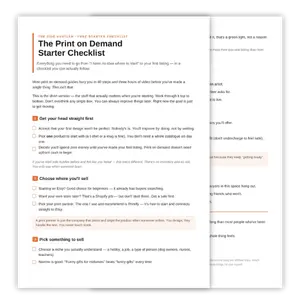
Download Your Free Print on Demand Starter Checklist
The two-page checklist that takes you from ‘no idea where to start’ to your first live listing — yours the second you sign up.
How to Get Started Today
You’ve got enough to make the call.
Most beginners reading this are better served starting with Printify, the lower costs, wider range, and flexible supplier network make it the more forgiving place to learn. Once you know what sells and you’ve got some momentum, you can always reassess.
Set up your free Printify account and connect it to your Etsy shop. Pick one product, create one design, and get your first listing live this week. That’s the whole job right now.
If you want the full beginner walkthrough before you dive in, the print on demand side hustle guide covers everything from how the model works to driving your first traffic.