
Table of Contents

This post contains affiliate links. If you click through and buy something, I may earn a small commission — at no extra cost to you. I only recommend tools I’ve actually used or thoroughly researched.
Blogging mistakes are something I know from personal experience, I’ve made most of the ones on this list. Some cost me months of wasted effort. A couple cost me real money. All of them were avoidable with the right information upfront.
This post exists so you don’t have to repeat them.
I’ve been running thesidehustler.blog for over two years. The mistakes I made early on are the same ones I see new bloggers making constantly, and they almost always come down to the same handful of avoidable decisions.
Most of these are fixable after the fact, so if you recognize a few of them already, that’s not a disaster, it just means you know what to fix next. The one genuine exception is the very first mistake below: platform choice is painful and costly to undo once you’re established.
Here’s the honest list of common blogging mistakes, and the exact fix for each one.
Ready to start the right way? Hostinger gets your blog set up on self-hosted WordPress in under an hour, from $2.69/month with a free domain. Avoid mistake #1 before you begin.
The 13 Most Costly Blogging Mistakes (And How to Fix Them)
Mistake 1: Starting on the Wrong Platform
The first blogging mistake many people make is starting on a free platform, WordPress.com, Wix, Blogger, because it costs nothing upfront.
The problem: free platforms limit what you can do with your blog. You can’t run certain affiliate programs. You have limited control over monetization. You’re building on someone else’s land, which means your blog can be removed, restricted, or changed without your consent. And if you ever want to move, you often lose SEO rankings in the process.
Self-hosted WordPress on your own hosting is the right foundation, WordPress.org itself recommends self-hosting for anyone serious about growing a site. It costs very little, Hostinger’s Premium plan starts from $2.69/month with a free domain included, and it gives you complete control over your blog, your monetization, and your content.
Start right. Moving platforms later is painful and costly.
Mistake 2: Writing for Yourself Instead of Your Reader
The second most common blogging mistake: writing what you want to write, not what your reader wants to read.
Your opinion on a topic might be interesting. But unless someone is actively searching for it, it won’t bring organic traffic. Every post you write should answer a real question someone is typing into Google.
Before writing any post, ask: would someone search for this? What would they type? If you can’t answer that, you probably shouldn’t write the post yet.
Recommended reading: How to Write a Blog Post That Gets Read and Ranks

Mistake 3: Ignoring SEO From the Start
SEO, search engine optimization, is how Google finds your blog. Ignore it when you start and you spend the next six months wondering why nobody can find your posts.
The basics take about ten minutes per post and make a real difference over time. Focus keyword in the title, in the first sentence, in at least one H2, in the meta description. Internal links. A couple of external links to authoritative sources.
That’s most of it. Install Rank Math before you publish your first post and it’ll walk you through the checklist automatically. Also set up Google Search Console from day one, it’s free and shows you exactly how Google sees your site.
Recommended reading: SEO Guide for Beginners: 8 Simple Steps to Get Your Blog Found
Mistake 4: Choosing a Niche You’ll Burn Out On
Picking a niche for the money rather than real interest is one of the blogging mistakes beginners make most often, and it kills blogs slowly. You start strong, write ten posts, and then realize you have nothing more to say, or worse, nothing more you want to say.
Your niche doesn’t need to be your deepest passion. But it needs to be a topic you can write about consistently for two or three years without running dry. Curiosity and real interest are more sustainable than enthusiasm alone.
The other version of this mistake: picking a niche so broad it’s impossible to build authority in. “Lifestyle” is not a niche. “Budget travel for solo female travelers over 40” is a niche. Specificity builds authority faster.
Recommended reading: How to Choose a Blog Niche: 5 Simple Steps to Find the Right One
Mistake 5: Not Building an Email List From Day One
This is the blogging mistake I hear the most regret about from established bloggers.
The reasoning goes: “I’ll start my email list once I have traffic.” But traffic isn’t guaranteed. Algorithms change. Google rankings fluctuate. Pinterest reach goes up and down. An email list is the only audience you truly own, nobody can take your subscribers away from you.
Start your email list before you have a single reader. Set up a simple opt-in form and let it collect subscribers from day one. Even 50 engaged subscribers are more valuable than 5,000 passive social followers.
If you’re choosing an email tool, Kit (formerly ConvertKit) is a solid place to start, its free plan covers you up to 10,000 subscribers. Sign up for Kit here.
Recommended reading: How to Build a Blog Email List From Scratch

Mistake 6: Publishing and Hoping
Publishing a post and waiting for traffic to arrive is one of the most demoralizing blogging mistakes you can make, because it almost never works, especially for a new blog.
Your content needs to be actively promoted, particularly while you’re building domain authority and Google hasn’t started ranking you yet.
Pinterest is one of the best early-stage promotion channels for bloggers. Unlike Google, which takes months to trust a new site, Pinterest can drive meaningful traffic within weeks of consistent pinning. Create a business account, design simple pin graphics in Canva, and link every pin back to your posts.
Email is the other channel, every new post should go out to your list, even when that list is small.
Mistake 7: Treating Every Post the Same
Not all blog posts have the same purpose. Some are written to rank in Google and drive traffic. Some are written to convert readers into buyers. Some are written to build trust and keep readers coming back. Some do several of these at once.
The mistake is writing every post the same way without thinking about what it’s supposed to achieve.
A product review should be structured to help someone make a buying decision: clear recommendation, honest pros and cons, affiliate link placed naturally. An informational post should establish expertise and funnel the reader toward a more conversion-focused post. A personal story post builds trust in a way a how-to guide never can.
Think about the purpose before you write. Structure follows purpose.
Mistake 8: Obsessing Over Design Instead of Content
A pretty blog with no content ranks nowhere and earns nothing. A slightly rough blog with 50 well-written, well-optimized posts will outperform it every time.
New bloggers routinely spend weeks choosing themes, tweaking colors, and redesigning headers instead of writing. Every hour spent on design at the expense of content is an hour not spent building the thing that actually drives traffic and income.
Pick a clean, simple free theme, Astra or Kadence are both excellent, get it looking decent in a couple of hours, and then leave it alone and write.
You can redesign when you have traffic worth designing for.
Mistake 9: Giving Up Too Soon
If there’s one blogging mistake that costs people more than all the technical errors combined, it’s this one.
Most blogs fail not because the niche was wrong or the writing was bad. This is really why blogs fail: the blogger quit between month three and month six, exactly the period when it feels like nothing is working and it’s tempting to conclude it never will.
Google takes time to trust new sites. Email lists take time to build. Pinterest traffic takes time to compound. The results you’re working toward in month one arrive in month six or month twelve, and they compound from there.
The bloggers who stick around almost always get there. The ones who give up at month four never find out.

Mistake 10: Writing Without a Content Strategy
Publishing posts randomly, with no plan for how they connect or what they’re building toward, is one of the quieter blogging mistakes, it doesn’t feel wrong in the moment, but it slows everything down.
A basic content strategy means having a plan: a pillar post that covers your main topic comprehensively, and a set of supporting posts that link back to it and go deep on specific sub-topics. This cluster structure is how Google identifies authority in a niche and rewards it with rankings.
Without a plan, you end up with a collection of disconnected posts. With one, you end up with a site that Google sees as authoritative on a specific topic.
Recommended reading: Blog Content Strategy: How to Plan Posts That Grow Your Traffic
Mistake 11: Ignoring Internal Links
Internal linking, linking your posts to each other, is one of the simplest, most effective SEO improvements you can make, and it’s consistently overlooked by new bloggers.
Every post should link to at least three to six other relevant posts on your blog. Not crammed in awkwardly, woven in naturally where they genuinely add value. This keeps readers on your site longer, helps Google understand your content structure, and signals which posts are most important.
Set a rule: before you publish any post, add your internal links. After you publish a new post, go back and add links to it from three older posts.
Mistake 12: Not Treating Your Blog Like a Business
This one is more mindset than tactics, but it underpins all the others.
Bloggers who succeed treat their blog as a business from day one: they have a plan, they track what’s working, they invest time consistently, and they make decisions based on data rather than how they feel on any given Tuesday.
Bloggers who don’t succeed often treat blogging as a hobby that might accidentally become a business, showing up when motivated, stopping when it gets hard, and wondering why the results are inconsistent.
You don’t need to spend 40 hours a week on it. But you do need to show up consistently, make decisions deliberately, and play a long enough game to see the results compound.
Mistake 13: Letting AI Write Your Blog For You
I’ve saved the most expensive mistake I made for last, because it’s the one that nearly ended this blog.
When I started out, I leaned far too heavily on raw AI content. It felt like a shortcut: faster posts, less effort, more published. Then Google’s Helpful Content system caught up with it, and nearly every page on my site dropped out of search almost overnight. Months of work, gone, and Google doesn’t tell you exactly what you did wrong, so digging back out is slow and frustrating. I’ve written more about that whole rebuild, and what it taught me, in a separate post if you want the longer version.
Here’s the part worth holding onto, though: AI isn’t the enemy. Leaning on it as a crutch is. I’ve since spent a long time building an AI setup around Claude that helps me rather than working against me, and the difference is that I’m in charge of it, not the other way around. It supports the research and the groundwork. The judgment, the experience, and the voice stay mine.
Use AI as an assistant, never as the author. Keep yourself in the driver’s seat and you’ll stay on the right side of Google, and your readers.
Start Without Making These Mistakes
The best time to start your blog was six months ago. The second best time is now, but now armed with the knowledge of what not to do.
Get your foundation right: self-hosted WordPress on Hostinger, SEO plugin installed, email list started from day one.
Then write consistently, promote actively, and stay in the game long enough to see the compound effect kick in.
Recommended reading: How to Start a Blog in 2026 (Simple Step-by-Step Guide)
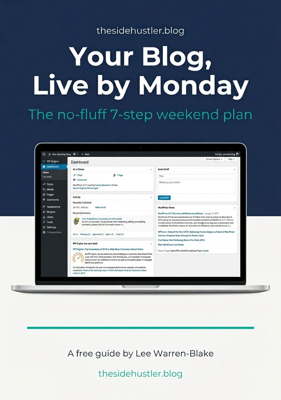
Download Your Free Blog Launch Roadmap
Get the no-fluff 7-step weekend plan that takes you from blank page to live blog — free instant download.
Which of these mistakes hit closest to home? Drop it in the comments, you’re definitely not the only one.
