
Table of Contents

This post contains affiliate links. If you click through and buy something, I may earn a small commission — at no extra cost to you. I only recommend tools I’ve actually used or thoroughly researched.
You can build wealth on a normal income. I know that doesn’t sound true — it sounds like something other people do. People with spare money, a finance degree, and a spreadsheet they actually understand.
I’m none of those things. But I’ve slowly built a life I own, working from home, on my own terms, and almost none of it came from being clever with money. It came from a few boring habits and one bigger decision most people skip.
That decision is the whole point of this article. So I’m going to give you both halves: the easy stuff that helps, and the harder thing that actually moves the needle.
The short version
If you only read the box, read this:
- Start with the boring saving habits. They’re easy and they work.
- But you can only cut so far. The real lever is earning more.
- The smartest way to earn more is to build something that keeps paying you, an asset, not just a second job.
- Pick one thing from the back half of this list and start it this week. Not someday. This week.
First, the part everyone gets right (and it still matters)
You can’t build anything on top of a leaky bucket. So we start here. But don’t get stuck here, this is the warm-up, not the workout.
1. Automate it so you never have to decide
The problem with saving “whatever’s left over” is that there’s never anything left over. Life happens. The money’s gone.
So take the decision away from yourself. Set up an automatic transfer to a separate savings account the day you get paid. Even a small amount. You won’t miss what you never see.
I’ve gone deeper on the small habits that quietly add up in my post on frugal habits that build wealth.
2. Cancel the stuff you forgot you’re paying for
Open your bank statement and read every recurring charge out loud. You’ll find at least one you forgot about. Probably three.
Cancel them today. Then send that exact amount to your savings instead. You’ll never have to do that bit of work again, the saving keeps happening every month on its own.
More easy wins like this in how to save more money in 2026.
3. Cut the big costs, not the small joys
Everyone tells you to give up your coffee. Honestly? Skip that advice. The small treats keep you sane.

The real money is in the big three: where you live, what you drive, and what you eat. Trim one of those properly and you’ll save more in a month than a year of skipped lattes. I worked out a lot of this when I started saving money while working from home.
4. Give yourself a small buffer
One bad month shouldn’t undo a year of progress. A small cushion, even a few hundred, means a surprise bill doesn’t wipe you out or push you into debt.
It’s not exciting. It’s not meant to be. It’s the thing that stops you starting over. If you want a no-fluff breakdown of how much to actually aim for, the Consumer Financial Protection Bureau has a useful guide to building an emergency fund.
Now the part most “build wealth” lists tiptoe around
Here’s the honest truth those four tips won’t tell you on their own.
You can only cut so far. There’s a floor under your spending, you still need a roof and food. But there’s no ceiling on what you can earn. That’s the side of the equation with all the room in it.
And the best kind of earning isn’t a second job that eats your evenings. It’s building something that keeps paying you after the work is done. That’s what “asset” actually means in plain English: a thing you make once that earns more than once.
This is the part that changed everything for me. So let’s spend the rest of the list here.
5. Stop trading hours, start building something
A second job pays you once, for the hours you put in. Stop showing up and the money stops too.

An asset is different. You build it once and it keeps selling while you sleep, walk the dog, or do literally anything else. It’s slower to start and far better once it’s going.
Not sure what that could look like for you? Start with my honest list of side hustles that actually work, or how to pick one and get going.
6. Print on demand: make it once, sell it forever
This is the asset I’d point most beginners to. You design something simple, a print partner prints and ships it when someone buys, and you never touch stock or spend money upfront.
The print partner I use and recommend is Printify, it’s free to start and connects straight to Etsy. Here’s my honest Printify review, warts and all, and the full beginner’s walkthrough if you want the whole thing start to finish.
Want the shortcut? I made a free one-page Print on Demand Starter Checklist, the exact steps to go from “no idea where to start” to your first live listing, with none of the overwhelm.
7. Sell printables: the lowest-cost asset there is
If print on demand still feels like a lot, printables are the gentlest way in. A planner, a checklist, a budget template, you make it once in Canva, list it, and it sells as a download forever. No printing, no shipping, no stock at all.
Start with how to make printables to sell, and if you want to know whether it’s actually worth it, I broke down how much you can really make selling printables, honest numbers, not hype.
8. Turn a skill into a digital product
You almost certainly know how to do something other people would pay to skip learning. A spreadsheet, a meal plan, a guide, a template, that’s a digital product.
Make it once, sell it again and again. Here are digital products that sell like crazy and the higher-profit ones worth your time.
9. Sell what you can already make in Canva
If you’re handy in Canva, you’re closer than you think. Social media templates, planners, and printables all sell well, and the design work is the part you can already do.
I walk through it in how to make money with Canva and selling Canva templates on Etsy.
10. Use a flexible side hustle to fund the assets
Here’s a move nobody mentions: use a flexible side hustle to bankroll the slow-burn assets. The side hustle pays you now. The asset pays you later. Run both for a while and the later one quietly takes over.
If you need cash sooner, these flexible side hustles are a good start, and becoming a virtual assistant from home is one of the quickest to land.
11. Reinvest what you earn instead of spending it
When that first bit of money comes in, the temptation is to spend it. Don’t, not all of it. Feed it back in.
A few dollars on better designs. A small budget to test more listings. The thing grows faster when you let it eat its own profits for a while. When you’re ready to treat it like a real shop, here’s how to scale a printables business.
12. Start before you feel ready
Here’s the one that matters most, and the one nobody can do for you.
I’ve watched so many smart people gather every bit of knowledge and never make the thing. Not because they couldn’t, because preparing feels safe and starting feels exposed.

I get that more than most. Coming through something serious a few years back taught me something blunt: waiting for the perfect moment is just a slower way of never doing it. There isn’t a perfect moment. There’s just this week.
So pick one idea from the back half of this list and start it. Today, if you can. It won’t be perfect. It’s not supposed to be. It just needs to exist.
Frequently Asked Questions
Can you really build wealth on a normal income?
Yes, but slowly, and mostly by earning more rather than only saving. Cutting costs has a floor. Building something that earns doesn’t. Most normal people who get there do it by stacking small habits and one income-earning asset over time.
What’s the easiest asset to start with?
For most beginners, printables or print on demand. Both let you make something once and sell it again and again, with little or no money upfront. Start with printables if you want the gentlest entry, or print on demand if you fancy selling physical products without holding stock.
How much money do I need to start?
Close to nothing. Printables cost nothing but your time. Print on demand is free to begin, you only pay a print partner once someone actually buys. That’s the whole appeal: no risk, no inventory.
How long until I see anything?
It usually takes longer than you’d like and comes sooner than you fear. Your first sale might take weeks. But the first one changes how the whole thing feels, and the asset keeps working long after you’ve made it.
One Last Thing
You don’t need a big salary, a finance degree, or perfect timing. You need a couple of boring habits to stop the leaks, and one thing that earns while you’re not looking.
Pick that one thing this week. If you want a map for the print-on-demand route, my free starter checklist lays out every step for you. Grab yours below.
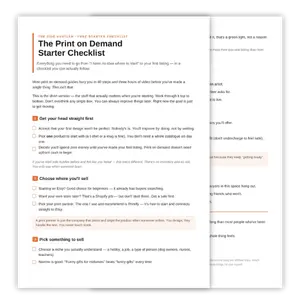
Download Your Free Print on Demand Starter Checklist
The two-page checklist that takes you from ‘no idea where to start’ to your first live listing — yours the second you sign up.
Go make a start. Then come back and tell me when it’s live, I’d genuinely love to hear it.
