
Table of Contents

This post contains affiliate links. If you click through and buy something, I may earn a small commission — at no extra cost to you. I only recommend tools I’ve actually used or thoroughly researched.
If you’ve been selling print on demand on Etsy for a while and things are starting to move, Amazon is probably the next question that crosses your mind. The traffic is enormous, the passive income potential is real, and it keeps coming up in every POD conversation online.
So here’s an honest look at Merch by Amazon print on demand, how it works, what the limitations are, and whether it’s worth adding to a POD strategy that’s already running on Etsy. I haven’t used it personally yet, so this isn’t a “here’s what worked for me” post. It’s a research-backed evaluation of whether it makes sense as a next step, and for who.
What Is Merch by Amazon Print on Demand?
Merch by Amazon print on demand is Amazon’s own POD program, now officially called Amazon Merch on Demand, though most people still know it by the original name. You upload designs, Amazon creates the product listings, and when a customer orders, Amazon prints the item, ships it via Prime, and pays you a royalty. You never handle the product, never pay upfront for stock, and never deal with fulfillment.
The difference between the selling price and Amazon’s cut, production costs plus their margin, is your royalty. As of a June 2026 restructure, Amazon moved from a flat royalty rate to a three-tier system based on where your traffic comes from. The default Creator Tier pays $2.44 on a standard $19.99 t-shirt if you’re relying entirely on Amazon’s own organic search and browsing traffic. Sellers who drive a meaningful share of external traffic to their listings can qualify for the higher Plus or Premium tiers instead, and royalties climb further on premium products like hoodies.
Two things make Merch by Amazon different from most POD setups: it’s invitation-only, and it starts with significant slot restrictions. You apply, you wait to be approved, and when you’re accepted you begin with just 10 listing slots. Those slots only increase as you make sales, tier up to 25, then 100, then 500, and so on.
That invitation-only model is the first meaningful friction point. You can’t just sign up and start listing the way you can on Etsy or with Printify. And with only 10 slots to start, your first design choices matter more than they would anywhere else.
For the full picture on how print on demand works before getting into the Amazon-specific detail, the what is print on demand post covers the basics clearly.
How Merch by Amazon Differs from Selling on Etsy
For anyone already running an Etsy POD shop, these are the differences that actually matter.
Traffic
Amazon’s buyer base is enormous, hundreds of millions of active shoppers. That scale is attractive. But scale also means competition at a level that’s harder to navigate than Etsy. On Etsy, a well-targeted listing in a specific niche can surface surprisingly quickly because you’re competing with a smaller pool of sellers. On Amazon, you’re competing with millions of designs across a platform where established sellers with large catalogs and advertising spend have a big head start.
The traffic is real. So is the competition.
Royalties vs Margins
On Etsy with Printify, you set your own price and keep the margin after base costs and fees. A mug selling for $19 with a $9 base cost and $2 in Etsy fees leaves you $8. That margin is yours to control.
On Merch by Amazon, the royalty structure isn’t something you set yourself. At a $19.99 price point for a standard t-shirt, the default Creator Tier pays $2.44 as of the June 2026 tier restructure, with higher Plus and Premium tiers available if you bring your own external traffic. You don’t control the production cost, Amazon does. And you have less flexibility on pricing than you do on Etsy.
Whatever tier you land in, it’s real self-employment income the moment it hits your account. The reporting side, the 1099-K, quarterly estimated payments, works the same way it does for any other Amazon seller, and I go through the mechanics in Amazon FBA taxes. One difference worth knowing: that post leans heavily on cost of goods sold, which applies to inventory-based FBA selling and not to royalty income here, since Amazon owns the production side of Merch listings entirely.
Control
On Etsy, you control your listings, your pricing, your shop identity, and your customer communication. You’re building something that feels like yours. On Merch by Amazon, Amazon controls the listing format, the pricing guardrails, and the entire customer relationship. You’re a design supplier on their platform, not a shop owner.
That’s not necessarily bad. But it’s a different relationship with the business than most Etsy sellers are used to.
Approval and Tier Limits

Etsy is open to anyone with a verified account. Merch by Amazon requires an application, a variable waiting period, and a slow progression through tier levels based on sales. Getting started is not as immediate, and for someone who wants to test a niche quickly, that friction matters.
The Case For Adding Amazon to Your POD Strategy
With all of that said, there are real reasons why Amazon is worth having on the radar.
Traffic scale. Even a small fraction of Amazon’s buyer base converting on your designs is meaningful volume. People arrive on Amazon to buy, not to browse. If your designs surface in the right searches, the conversion rate can be strong.
Hands-off once it’s working. A well-performing Merch by Amazon listing earns without ongoing marketing effort. No Pinterest pins, no Etsy SEO updates, no external traffic strategy required. That’s a different kind of passive than Etsy, where algorithm changes and competition require more ongoing attention.

Diversification. Relying entirely on Etsy is a real risk. Etsy has changed its fee structure, its algorithm, and its seller policies multiple times. Spreading your designs across two platforms with very different traffic sources reduces single-platform dependency, and that’s worth something as a long-term business decision.
No additional supplier cost. Merch by Amazon is self-contained. You upload designs directly to Amazon, no Printify account needed for the apparel side. That simplicity has value, particularly for sellers who want a second channel without adding operational complexity.
The Case Against (Or: Why Most POD Sellers Start Elsewhere)
The honest limitations that the enthusiastic YouTube videos tend to skip over.
Invitation only. You can’t start today. The application process takes time and approval isn’t guaranteed or fast. Some sellers wait weeks. Some wait months. If you’re at the beginning of your POD journey and you need momentum quickly, Etsy is a faster path to a first sale.
Tier limits are a real constraint. Starting with 10 slots means 10 products maximum until you’ve made enough sales to unlock the next tier. For a beginner who hasn’t validated their niche or designs, 10 shots is a tight proving ground. On Etsy with Printify, you can list 50 products in your first week and learn what resonates fast. That flexibility matters early on.
Royalties are lower than Etsy margins. At comparable price points, the per-sale return on Merch by Amazon is typically lower than what a well-priced Etsy listing returns through Printify, especially since the June 2026 tier restructure cut the default royalty rate. The volume potential of Amazon’s traffic can offset this, but only once your listings are actually surfacing, which takes time and a proven catalog.
Less brand control. You can’t build a recognizable shop identity on Merch by Amazon the way you can on Etsy. There’s no shop banner, no About section, no way for a buyer to discover your other designs through a branded storefront. Each listing stands alone.
The competition is fierce. Breaking through on Amazon without advertising spend is possible, but harder than Etsy for most niche products, particularly in the early stages before you have any sales history or reviews.
Who Should Consider Adding Merch by Amazon?
Not the right move for everyone at every stage. Here’s the honest steer for anyone weighing merch by amazon for beginners against just staying on Etsy.
Merch by Amazon makes sense for:
Established Etsy sellers with a proven catalog who want a second passive income stream without adding supplier complexity. If you already know which designs sell, uploading them to Amazon is a low-effort expansion.
Sellers with designs that have broad, mainstream appeal. Amazon’s audience is less niche-driven than Etsy’s, the kind of specific, community-insider designs that thrive on Etsy may not surface as easily on Amazon’s larger, broader search results.
Merch by Amazon is not the right first move for:
Complete beginners who haven’t validated their niche or designs yet. The tier limits and application process make it a frustrating starting point. Etsy first, validate your designs, understand your audience, then consider Amazon as a second channel.
Sellers whose strategy is built around highly specific, gift-driven niches. Pinterest and Etsy are better suited to that kind of targeted, seasonal, identity-driven buying behavior than Amazon’s search model.

How to Apply for Merch by Amazon
The process for print on demand amazon is straightforward, even if the timeline isn’t.
Go to merch.amazon.com and request an invitation. Amazon will ask you to fill in a brief application covering your intended niche and plans for the account. Being specific helps, “I plan to create niche-specific apparel for dog breed enthusiasts and pet owners” is more compelling than “I want to sell t-shirts.”
Once submitted, you wait. There’s no fixed timeline, approval can come in days or take several months. There’s no way to chase it. You submit and move on.
When you’re approved, treat your 10 initial slots carefully. Use what you already know works, your best-performing Etsy designs, your most validated niche ideas. Every sale counts toward unlocking the next tier, so your first 10 listings need to be your strongest 10.
One thing worth knowing: Merch by Amazon’s catalog has expanded beyond just apparel, it now includes phone cases, PopSockets, tote bags, and throw pillows directly. Mugs are the notable exception, if you want to sell those on Amazon, you’d still need a third-party supplier like Printify connected to an Amazon Seller account. That’s a more complex setup, but worth flagging for anyone whose POD catalog is built around drinkware.

Merch by Amazon vs Etsy: Which Should You Focus On?
Here’s the straight answer for merch by amazon vs etsy.
Start with Etsy. For almost everyone, almost every time. The open platform, faster setup, niche-friendly algorithm, controllable margins, and no approval process make it the better proving ground, particularly for the kind of specific, identity-driven designs that POD does best.
Add Amazon when you have a proven catalog and you’re ready to diversify. The same designs that sell on Etsy can often be uploaded to Merch by Amazon with minimal adaptation. You’re not starting again, you’re extending what’s already working into a second channel with different traffic.
The two aren’t mutually exclusive. They’re complementary, different audiences, different buying behavior, different strengths. But the sequence matters. Etsy first, Amazon second.
If you haven’t started on Etsy yet, the print on demand on Etsy guide covers the full setup from account creation to first listing. And if you’re still evaluating the broader platform landscape, the best print on demand sites post covers all the main options in one place.
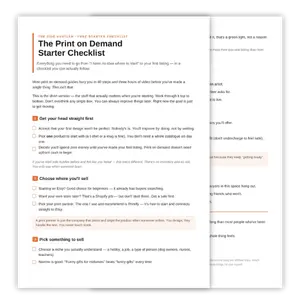
Download Your Free Print on Demand Starter Checklist
The two-page checklist that takes you from ‘no idea where to start’ to your first live listing — yours the second you sign up.
Ready to Take the Next Step?
Merch by Amazon print on demand is a legitimate channel worth having on your radar, but it’s not where most people should start, and it’s not the right move until you’ve got something working on Etsy first.
If you’re just getting into print on demand, the print on demand side hustle guide is the place to begin. If you’re already selling on Etsy and thinking about expanding, go to merch.amazon.com and put in your application. The wait is worth it, but only once the foundation is already there.
