
Table of Contents

This post contains affiliate links. If you click through and buy something, I may earn a small commission — at no extra cost to you. I only recommend tools I’ve actually used or thoroughly researched.
Let’s get one thing out of the way first. You’ll see the word “fast” attached to this topic all over Pinterest, and it deserves some honesty.
You can make money on Pinterest. Plenty of bloggers and content creators do, including me. But “fast” is relative. If you’re expecting to pin a few products today and wake up to commissions tomorrow, that’s not how it works.
What Pinterest does offer is something more valuable than quick money: durable, compounding income that grows over time. Pins you create today can still be driving traffic and revenue six months from now. That’s not something most platforms can offer.
This guide covers every realistic strategy for making money on Pinterest in 2026, what works, what doesn’t, and what you need in place before any of it pays off. If you’re searching for how to make money on Pinterest for beginners, honest and realistic rather than hype, this is written for you specifically.
Recommended reading: Pinterest Affiliate Marketing
What You Actually Need Before You Can Make Money on Pinterest
Before we get into the strategies, let’s be straight about the foundations. Pinterest doesn’t pay you directly for views or impressions, its Creator Rewards program, which briefly paid creators, is no longer running. Every strategy for making money on Pinterest today uses Pinterest as a traffic source, not a payment source.
That means you need somewhere to send that traffic. Usually one of these:
- A blog: your content hub where affiliate links, ads, and product offers live
- An email list: where you build relationships that convert to sales over time
- A product or service: something you sell directly
Pinterest is the engine that drives people to these things. The money comes from what you’ve built off-platform, that’s really the whole secret behind every one of these pinterest income strategies.

If you don’t have any of these yet, start there before worrying about Pinterest monetization. The good news is that building a blog and Pinterest presence at the same time makes sense, they feed each other.
Recommended reading: How to Start a Profitable Blog
Free Pinterest Training Workshop
Content ideas are only useful if your Pinterest strategy is solid enough to make them work. Meagan Williamson’s free workshop — The Discovery Loop — covers the full system so your content gets found.
Strategy 1: Affiliate Marketing Through Your Blog
This is the most accessible and most commonly used strategy for making money on Pinterest, and it’s the one I’d point most bloggers toward first.
The mechanic is simple. You write blog posts that naturally recommend products or services you earn a commission on. You create Pinterest pins that drive traffic to those posts. When readers click your affiliate links and buy, you earn.
What makes this work on Pinterest specifically is the intent of its users. They come to the platform actively searching for ideas, solutions, and recommendations. According to Pinterest’s business resources, the large majority of top searches are unbranded, people are hunting for ideas, not specific brands. A pin that leads to an honest, helpful review or comparison post lands with an audience that’s already in research mode, often close to a buying decision.
The blog posts that convert best for Pinterest affiliate marketing:
- Honest product reviews
- Tool comparisons (“X vs Y”)
- “Best of” roundups for your niche
- How-to guides that recommend a tool as part of the solution
The key word throughout is honest. Readers can tell when a recommendation is real and when it’s just a commission grab. Write like you’re recommending something to a friend, earn the recommendation before you make it.
Full guide: Pinterest Affiliate Marketing
Strategy 2: Display Advertising on Your Blog
If Pinterest is driving traffic to your blog, you can monetize that traffic with display ads, without selling anything directly. This is one of the more passive ways to monetize Pinterest traffic once you have enough of it.
Ad networks like Google AdSense, Mediavine, and Raptive (formerly AdThrive) pay you for impressions and clicks on ads displayed on your blog. The more traffic you drive, the more you earn.
Pinterest traffic converts well for display ads because Pinterest users tend to read content thoroughly, they arrived with intent, they found what they were looking for, and they stick around. That’s valuable ad inventory.
The catch is that display ad income at low traffic levels is minimal. You need real volume before ad revenue adds up to much. Mediavine requires a meaningful amount of monthly traffic to join (with lower-tier options for smaller sites), and Google AdSense has no minimum but pays very little at low traffic.
Think of display ads as a passive layer on top of your affiliate strategy, not a primary income source until your traffic is substantial.
Strategy 3: Selling Your Own Digital Products
If you have a digital product, an ebook, a course, a template, a printable, Pinterest is an excellent traffic source for it.

Pinterest users are planners and researchers. They save content they intend to come back to. A well-targeted pin that leads to a landing page for a relevant digital product can convert surprisingly well, especially in niches like personal finance, meal planning, home organization, blogging, and side hustles.
The advantage of selling your own products over affiliate marketing is the margin. You keep 100% of the revenue rather than earning a percentage. The disadvantage is that you need to create the product first, which takes time and effort upfront.
For bloggers, the most practical starting point is a low-cost digital product that solves a specific problem your readers have, a template, a checklist, a mini-course. Price it accessibly, drive Pinterest traffic to it, and use it to build your email list at the same time.
Recommended reading: Digital Products That Sell Like Crazy
Strategy 4: Building an Email List That Converts
This one doesn’t make you money directly from Pinterest, but it’s arguably the highest-value thing you can do with Pinterest traffic.
Pinterest readers who join your email list become a warm audience you can market to repeatedly. A single Pinterest visitor might read one post and leave. An email subscriber might buy from you three times over the next year.
The strategy is straightforward:
- Create pins that lead to your best lead magnet posts or landing pages
- Offer something truly useful in exchange for an email address, a free guide, a checklist, a template
- Build a welcome email sequence that delivers value and introduces your paid offers naturally
Pinterest traffic that converts to email subscribers is worth far more than Pinterest traffic that just reads a post and bounces. Build this loop into your strategy from the start.
Full guide: How to Build Your Email List From Pinterest
Strategy 5: Direct Affiliate Links on Pinterest
It’s worth covering this option because it comes up a lot, pinning directly to affiliate links without a blog post in between.
It’s allowed on Pinterest for most affiliate programs, and it can work in certain niches, particularly visual ones like fashion, home decor, and beauty where impulse purchases are more common.
For most bloggers in the online income, personal finance, or side hustle space, it’s less effective than the blog post approach. Cold Pinterest traffic rarely converts at a product page without some warming up in between. The blog post does that warming up.
If you do use direct affiliate links on Pinterest, a few rules:
- Always disclose in your pin description, “affiliate link” or “I may earn a commission”
- Check that the affiliate program allows Pinterest links, not all do
- Make sure your pin clearly communicates what the product is and who it’s for
Strategy 6: Offering Pinterest Management Services
This one is a bit different, instead of using Pinterest to sell something, you sell your Pinterest knowledge as a service.

If you’ve built a solid Pinterest strategy for your own blog and understand how the platform works, other business owners will pay you to manage their Pinterest accounts. Pinterest management is a legitimate and growing freelance niche.
Services typically include account setup and fine-tuning, pin creation, scheduling, and monthly analytics reporting. Rates vary widely, from a few hundred dollars a month for basic management to considerably more for full-service strategy and execution.
This isn’t a passive income strategy. It trades time for money. But it’s a real income opportunity for bloggers who have developed real Pinterest expertise and want to monetize it while their own blog traffic is still growing.
If this interests you, it’s worth looking into Pinterest management training specifically. Meagan Williamson, whose beginners course I mention below, also teaches on the management side, worth a look at her site to see what she currently has available in that area.
How Long Does It Take to Make Money on Pinterest?
Honest answer: most people see their first meaningful Pinterest-driven income somewhere between three and six months in, assuming they’re building a blog, doing affiliate marketing, and pinning consistently throughout.

The timeline breaks down roughly like this:
Month 1–2: Building foundations. Traffic is slow. Pins are gaining traction. First few affiliate clicks but probably no conversions yet.
Month 3–4: Traffic starts to compound. Posts that have been getting Pinterest traffic for a while start converting. First affiliate commissions appear.
Month 5–6: If you’ve been consistent, Pinterest has figured out your audience. Traffic is more predictable. Affiliate income is small but real and growing.
Month 6+: The compounding effect kicks in properly. Old pins keep driving traffic. New pins build on established account authority. Income becomes more reliable.
That lines up with how it went for me, the first couple of months were quiet, a few clicks but little to show for it, and the income only started to feel real once my back catalog of pins began compounding.
This isn’t a guarantee, results depend on your niche, your content quality, your affiliate programs, and your consistency. But it’s a realistic picture of what to expect.
Free Pinterest Training Workshop
Content ideas are only useful if your Pinterest strategy is solid enough to make them work. Meagan Williamson’s free workshop — The Discovery Loop — covers the full system so your content gets found.
What Doesn’t Work for Making Money on Pinterest
A few pinterest money making tips worth knowing in reverse, the habits that quietly waste your time:
Pinning without a strategy. Random pinning without keyword research, consistent branding, or a clear niche produces random results, usually disappointing ones.
Promoting products you haven’t used. Readers can tell. And when they buy based on your recommendation and have a bad experience, you lose their trust permanently.
Expecting overnight results. Pinterest is a long game. The bloggers who make real money from it are the ones who stuck around long enough for the compounding to work.
Ignoring your analytics. If you’re not checking what’s working and adjusting, you’re leaving money on the table. The data tells you exactly what to do more of.
Relying solely on Pinterest. Pinterest is a traffic source, not a complete business. Build the email list, build the blog, build the product or affiliate portfolio. Pinterest drives people to those things, it doesn’t replace them.
The Simplest Path to Making Money on Pinterest
If you’re starting from scratch and want the clearest path to Pinterest income, here it is:
- Set up your blog and Pinterest business account properly: the foundations matter
- Join 2–3 affiliate programs relevant to your niche with decent commission rates
- Write 10–15 strong affiliate posts: reviews, comparisons, how-to guides with recommendations
- Create 3–5 pins per post and schedule them consistently
- Build your email list from your Pinterest traffic
- Check your analytics monthly and double down on what’s converting
That’s the whole system. It’s not complicated. It just takes time and consistency.
If you want a structured approach to building this system rather than figuring it out piece by piece, Meagan Williamson’s Pinterest course is worth a look. It covers the full setup, account, keywords, pins, and strategy, in a way that makes the whole thing click. It’s the course I took, and it’s built around what’s working now rather than outdated tactics.
Final Thoughts
Making money on Pinterest is real. It’s not fast, and it’s not passive from day one, but it becomes increasingly passive over time as your pins and posts keep working without you having to constantly create new content.
Build the foundations, be consistent, be honest in your recommendations, and give it enough time for the compounding to kick in. That’s the realistic path to Pinterest income in 2026.
Next step: Best Pinterest Niches in 2026
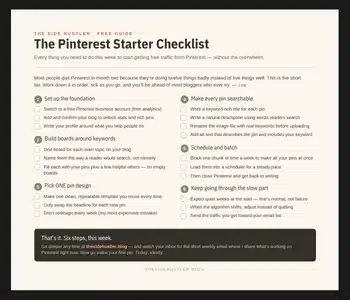
There’s no overnight money on Pinterest, but there is a right order to do things in, and it speeds everything up. The free Pinterest Starter Checklist below lays that order out, on one page. Grab it and start at step one.
Download Your Free Pinterest Starter Checklist
Grab the free one-page checklist that shows you exactly what to do first, next, and after that.
