
Table of Contents

This post contains affiliate links. If you click through and buy something, I may earn a small commission — at no extra cost to you. I only recommend tools I’ve actually used or thoroughly researched.
Pinterest and affiliate marketing are a natural combination. Pinterest users are planners and researchers — they come to the platform actively looking for ideas, solutions, and products. That’s exactly the mindset that makes someone receptive to an honest product recommendation.
Done right, Pinterest affiliate marketing means your pins keep earning long after you created them. A pin you made six months ago can still be driving clicks — and commissions — today. That’s the kind of durable income stream that makes Pinterest worth the effort.
This guide covers how Pinterest affiliate marketing works, the two main approaches you can take, and how to do it in a way that converts without damaging your audience’s trust.
Recommended reading: How to Make Money on Pinterest
How Pinterest Affiliate Marketing Works
The basic mechanic is simple. You share a pin that contains or leads to an affiliate link. When someone clicks that link and makes a purchase, you earn a commission.
There are two ways to approach this on Pinterest:
Option 1: Direct affiliate links on Pinterest. You create a pin and link it directly to your affiliate URL — no blog post in between. The reader sees your pin, clicks through, lands on the product or service page, and buys.
Option 2: Pins that link to a blog post. You create a pin that links to a blog post on your site. The blog post contains your affiliate links and does the selling. The reader goes pin → blog post → product.
Both work. But they work differently, and for most bloggers the second approach is a lot more effective. Here’s why.
Free Pinterest Training Workshop
Content ideas are only useful if your Pinterest strategy is solid enough to make them work. Meagan Williamson’s free workshop — The Discovery Loop — covers the full system so your content gets found.
Why the Blog Post Approach Almost Always Wins
When you link a pin directly to an affiliate product, you’re asking someone to go from a cold introduction — a Pinterest pin — straight to a purchase decision. That’s a big jump, especially for higher-ticket items.
When you link to a blog post first, you have space to:
- Build context around the product
- Share your honest experience with it
- Answer the questions your reader has before they buy
- Include multiple related affiliate links naturally
A well-written blog post warms the reader up. By the time they click your affiliate link at the end of a thorough, honest review or guide, they’re already most of the way to a buying decision.
Blog posts also give you better SEO — both on Pinterest (more keyword space) and on Google (your post can rank in both places). And they build trust with your audience in a way that a direct pin-to-product link never can.
This is the approach I use on this blog. Just about every affiliate link I have sits inside a post that does the explaining first — it converts better, and it’s fairer to the reader.
That said, direct affiliate links on Pinterest can work well for lower-cost products in visual niches — fashion, home decor, beauty — where the impulse buy is more natural. For blogging, side hustle, and make-money-online niches, the blog post approach is almost always stronger.
According to Pinterest’s community guidelines, affiliate links are allowed on Pinterest — but you must disclose that your pins contain affiliate links. This isn’t optional. Add a clear disclosure to your pin description when linking directly to an affiliate product.
Step 1: Choose the Right Affiliate Programs for Pinterest
Not every affiliate program is a good fit for Pinterest. The best ones share a few characteristics:
Visual products or solutions. Pinterest is a visual platform. Products and services that can be shown or demonstrated visually tend to perform better than abstract services.
Products your audience is actively searching for. Go back to your Pinterest keyword research. What are people in your niche searching for? The affiliate products that map to those searches are your best opportunities.
Programs that allow Pinterest links. Some affiliate programs restrict where you can share links. Always check the terms before pinning affiliate links. Amazon Associates, for example, has specific rules about where links can be shared — read their policies carefully.
Products you’ve actually used or researched thoroughly. This is non-negotiable. Recommending products you have no experience with destroys trust the moment your reader tries them and has a different experience than you described. Only promote what you truly believe in.
For bloggers in the online income space — which covers a lot of the thesidehustler.blog audience — strong affiliate programs for Pinterest include email marketing tools, blogging resources, Pinterest courses, and productivity tools.
Recommended reading: Affiliate Marketing for Bloggers
Step 2: Create Blog Posts That Are Built to Convert
If you’re using the blog post approach — which you should be — the posts you send Pinterest traffic to need to be set up to convert that traffic into affiliate commissions.
The posts that work best for Pinterest affiliate marketing:
Product reviews. A thorough, honest review of a tool or product you’ve used. Cover what it does, who it’s for, what you like about it, what you don’t, and whether you’d recommend it. Real reviews convert because they answer the questions a buyer has.
Comparison posts. “Tool A vs Tool B” posts work very well for Pinterest because they target readers who are already in decision mode. They’ve narrowed it down to two options and want help choosing.
“Best of” roundups. “Best email marketing tools for bloggers,” “best side hustle ideas for beginners” — these posts can include multiple affiliate links naturally and rank for broad search terms on both Pinterest and Google.
How-to guides with tool recommendations. A step-by-step guide that naturally recommends a tool as part of the process. The recommendation is earned because it solves a problem the reader is actively trying to solve.
In every case, the affiliate link should appear in context — where the recommendation is most natural — not just in a list at the bottom of the post.
Step 3: Create Pins That Drive Traffic to Your Affiliate Content
Once your blog posts are set up, you need pins that drive the right readers to them.
The key is matching your pin to the search intent of the reader most likely to convert. If your affiliate post is a review of an email marketing tool, your pin title shouldn’t just be “email marketing tips” — it should be something like “Best Email Marketing Tool for Beginner Bloggers (Honest Review),” which signals to the reader exactly what they’ll find and pre-qualifies them as someone interested in that kind of recommendation.
Pin design principles for affiliate content:
- Specific headline — tell the reader exactly what the post covers
- Benefit-driven — focus on what they’ll get, not just what the post is about
- Create multiple designs — different headlines target different search angles and audiences
- Point to your best converting posts first — identify which affiliate posts convert best and prioritize pinning to those
Full guide: Pinterest Pin Design
Step 4: Disclose Your Affiliate Relationships — Every Time
This isn’t optional and it isn’t something to bury in a footer. FTC guidelines require clear affiliate disclosure whenever you recommend a product you earn a commission from — and Pinterest’s own community guidelines require disclosure on affiliate pins.
In practice this means:
On your blog posts: A clear disclosure at the top of the post, before the first affiliate link. Something like: “This post contains affiliate links. If you click through and buy something, I may earn a small commission at no extra cost to you.”
On Pinterest pins that link directly to affiliate products: A disclosure in the pin description. Something like: “Affiliate link — I may earn a commission if you purchase through this link.”
Being upfront about affiliate relationships doesn’t hurt conversions — it builds trust. Readers who know you earn a commission and choose to click anyway are the most valuable clicks you’ll get.
Step 5: Track What’s Converting and Double Down
Pinterest affiliate marketing only improves when you pay attention to what’s working.
The basic tracking setup:
UTM parameters. Add UTM parameters to the URLs you use in your pins so Google Analytics can tell you which pins are sending traffic to your affiliate posts. This tells you which pin designs and headlines are driving the most valuable traffic.
Affiliate dashboard. Most affiliate programs have a dashboard showing clicks, conversions, and earnings. Check it regularly and note which posts and products are generating the most revenue.
Pinterest Analytics. Track which pins are getting the most outbound clicks. Cross-reference with your affiliate earnings to identify your highest-value pins.
Once you know which combination of pin + blog post + affiliate product is converting, create more content in that pattern. Scale what works.
Full guide: Pinterest Analytics Guide
What to Realistically Expect From Pinterest Affiliate Marketing
Pinterest affiliate marketing is not a get-rich-quick strategy. Let’s be clear about that.
In the early months, while your Pinterest account is still building authority and your blog posts are still gaining traction, commissions will be small. That’s normal. The value of Pinterest affiliate marketing is in the compounding — pins and posts that keep getting found, month after month, generating a steady stream of clicks and conversions without you having to create new content constantly.
That tracks with my own experience. The first commissions were small and sporadic, and it only started to add up once a handful of posts had been pulling Pinterest traffic for months.
The bloggers who earn meaningful income from Pinterest affiliate marketing are the ones who:
- Have built a library of well-targeted affiliate posts
- Pin consistently to drive ongoing traffic to those posts
- Have chosen affiliate programs with good commission rates and products people want to buy
- Have been doing it long enough for the compounding to kick in
Give it six months of consistent effort before drawing any conclusions. Pinterest affiliate income grows slowly and then suddenly — it’s not linear.
Pinterest Affiliate Marketing and Meagan’s Courses
If you want to go deeper on the strategy side of Pinterest affiliate marketing specifically, Meagan Williamson runs a dedicated Pinterest affiliate course that covers how to set up a Pinterest affiliate strategy from scratch — which niches work best, how to structure your pins, and how to stay within Pinterest’s guidelines on affiliate links.
For most beginners though, the free workshop is the right starting point — get your Pinterest foundations solid first, then layer the affiliate strategy on top.
Meagan’s free Pinterest workshop covers the fundamentals you need before affiliate marketing on Pinterest will work properly.
Free Pinterest Training Workshop
Content ideas are only useful if your Pinterest strategy is solid enough to make them work. Meagan Williamson’s free workshop — The Discovery Loop — covers the full system so your content gets found.
Common Pinterest Affiliate Marketing Mistakes
Promoting too many products at once. Focus on a small number of products you believe in. Scattering affiliate links across dozens of programs dilutes your efforts and makes your content feel like a catalog rather than a recommendation.
Skipping the disclosure. Non-disclosure isn’t just an ethical issue — it’s a legal one. Always disclose. Always.
Sending Pinterest traffic directly to affiliate links without warming them up. Cold traffic rarely converts at the product page. Build the blog post in between.
Ignoring the search intent of your audience. The best affiliate content answers a question your reader is actively asking. If your posts aren’t aligned with real search queries, they won’t get the Pinterest traffic needed to generate commissions.
Giving up too early. Pinterest affiliate marketing takes time. Most people quit before the compounding kicks in.
Final Thoughts
Pinterest affiliate marketing works because Pinterest users arrive with intent. They’re not passively scrolling — they’re looking for ideas, solutions, and recommendations. That’s the perfect mindset for an affiliate recommendation to land.
Build the right blog posts, drive consistent Pinterest traffic to them, and disclose your relationships honestly. Do that over time and Pinterest becomes one of your most durable income streams.
Next step: How to Make Money on Pinterest
Affiliate pins only pay once the basics are right underneath them. The free Pinterest Starter Checklist below gets those basics in place — your first week on one page. Grab it and build from there.
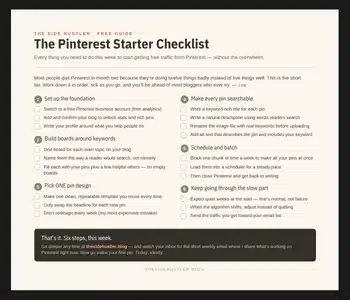
Download Your Free Pinterest Starter Checklist
Grab the free one-page checklist that shows you exactly what to do first, next, and after that.
