
Table of Contents

This post contains affiliate links. If you click through and buy something, I may earn a small commission — at no extra cost to you. I only recommend tools I’ve actually used or thoroughly researched.
Pinterest group boards used to be one of the most talked-about growth tactics on the platform. Join the right boards, pin to them consistently, watch your reach take off. That was the advice for years.
It’s 2026, and that advice has aged badly. I’ve had more group board invites than I can count, and I did jump on a few early on. These days I don’t bother — they do little to nothing for me now. Group boards still exist, and a handful still pull their weight, but the old “join as many as you can and pin hard” approach is finished. Pinterest’s algorithm moved on, and the tactic didn’t keep up.
This post gives you an honest picture of where group boards stand today, when they’re still worth using, and where to put your energy instead.
Recommended reading: Pinterest Strategy for Beginners
What Are Pinterest Group Boards?
For anyone new to Pinterest, a quick explanation. A group board is a board that multiple contributors can pin to. The owner creates it and invites other Pinterest users to join as collaborators. Everyone who joins can add pins, and those pins are visible to all of the board’s followers — not just the followers of the person who pinned.
The appeal, historically, was reach. If a group board had 100,000 followers, every pin you added to it was theoretically in front of all of them. For new accounts with small followings, that felt like a shortcut to a huge audience.
And that’s where the strategy made sense — back before Pinterest’s algorithm got a lot smarter.
Why Pinterest Group Boards Are Less Powerful Than They Used to Be
Pinterest has changed how it distributes content. In the early days, following and follower counts mattered more — content from boards you followed showed up prominently in your feed. A group board with a big following could genuinely amplify reach.
Today, Pinterest is far more focused on interest-based distribution. It shows people content based on what they’ve searched for, saved, and engaged with — not just what comes from boards they follow. Your home feed is curated by Pinterest off your behavior, not your following list.
That change gutted most of what made group boards useful. A board with 100,000 followers doesn’t mean 100,000 people see your pin — it means 100,000 people once chose to follow that board, most of whom now see a Pinterest-curated feed that may or may not include your content.
According to Pinterest’s creator resources, fresh pins from active creators get priority in distribution — regardless of which boards they’re saved to. Your own well-built boards, with strong keyword-rich descriptions and steady activity, will outperform a group board that has thousands of followers but little real engagement.
When Pinterest Group Boards Are Still Worth Using
That said, group boards aren’t completely dead. There are a few specific situations where they still add real value.
Highly Active, Niche-Specific Boards
A group board that’s tightly focused on one topic, actively managed, and filled with quality content from engaged contributors can still drive meaningful reach — especially for new accounts trying to build early momentum.
The key words are specific and active. A broad board called “Blogging Tips” with thousands of contributors and mixed-quality content is not the same as a tight board called “Pinterest Marketing for Bloggers” with 20 active contributors all creating quality pins in the same niche.
Building Initial Account Momentum
For brand new accounts, a group board can help while your own boards are still building authority. If you can join a well-run, niche-relevant one early, it gives your content a bit of extra exposure while Pinterest is still working out your audience.
This is a short-term play, not a long-term one. As your own account gains traction, the group board matters less and less.
Collaborative Content Creation
Some group boards work more as community resources than distribution tools — a collection of the best content on a topic, curated by several people. Joining these can be worthwhile for the networking and the community, even if the direct traffic is modest.
When Pinterest Group Boards Are Not Worth Your Time
Large, unfocused boards with hundreds of contributors. These are dumping grounds. Pinterest deprioritizes low-engagement boards, and one where hundreds of people pin hundreds of different things a day isn’t going to have strong engagement signals. Your pins get buried immediately.
Boards in your niche that haven’t been updated recently. An inactive group board is dead weight. Check when the last pin was added before you request to join.
Boards that make you repin other contributors’ content at a high ratio. Some group boards make members repin a set number of other pins for every one they add. That eats your time and floods your own boards with content that isn’t yours — which blurs your account’s niche focus.
Any board that feels spammy. If a group board is full of low-quality pins, keyword-stuffed descriptions, or unrelated content, being tied to it can hurt your distribution rather than help it.
What to Do Instead of Chasing Group Boards
If group boards aren’t the priority they once were, where should your energy go? The same place it always should have — your own boards and your own pins. That’s exactly where I’d tell you to put the time you’d otherwise burn hunting down group boards. It’s where I put mine.
Focus on Your Personal Boards
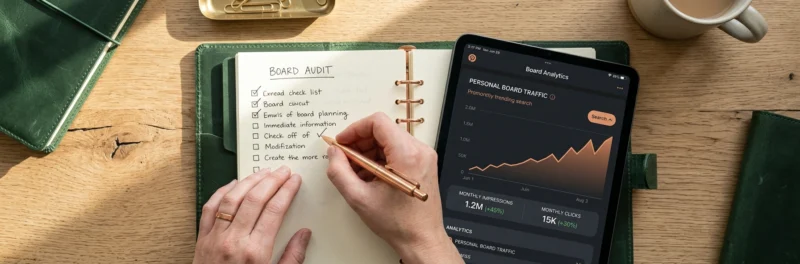
Your own boards, set up properly with keyword-rich titles and descriptions, are your most reliable distribution asset. Pinterest gives priority to fresh content from active accounts — and a well-kept personal board in a clear niche beats a mediocre group board consistently.
Spend the time you might have spent finding and applying to group boards on:
- Sharpening your existing board titles and descriptions
- Creating more pin variations for your best blog posts
- Building a consistent daily pinning schedule
Full guide: Pinterest Board Strategy
Use Tailwind Communities Instead
If you want the reach-sharing that group boards used to offer, Tailwind Communities — once called Tribes — is worth a look. I use Tailwind for scheduling myself, though I haven’t tried Communities specifically. From what I’ve researched, the sharing is more deliberate than a group board, the communities are better moderated, and the niche focus is tighter.
Here’s how it works: you add your pin to a community, other members can reshare it to their Pinterest audiences, and you do the same for them. The sharing is more deliberate than a group board, the communities are better moderated, and the niche focus is tighter.
For new accounts trying to build momentum, Tailwind Communities are worth exploring as an alternative to most group boards.
Full guide: How to Schedule Pinterest Pins in 2026
Create More Fresh Pins
Pinterest rewards fresh content — new images with new descriptions, even when they link to older blog posts. The time you’d spend managing group board memberships and hitting pinning ratios is almost always better spent making more fresh pin variations for your best content.
One extra pin variation per blog post per week adds up fast. Over six months that’s a real library of fresh content that keeps getting found in search — far more durable than group board exposure ever was.
How to Find and Join a Good Group Board
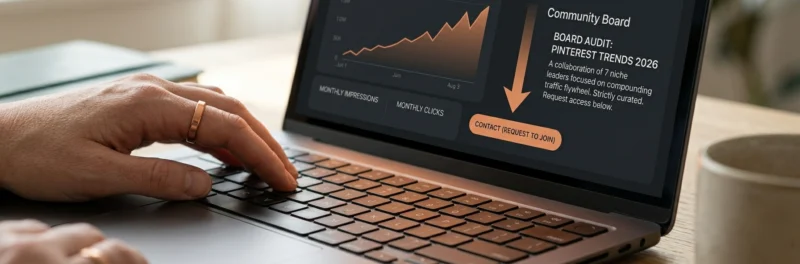
If you’ve read all of this and still want to try group boards — maybe you’re in a niche where they’re still active and well-run — here’s how to find the good ones.
Search Pinterest directly. Search your niche topic and filter by boards. Look for boards with multiple contributors and recent, quality content.
See what successful pinners in your niche contribute to. Find a well-performing account in your niche and check which boards they’re saving to. If they’re active on certain group boards, those are worth a look.
Check the board’s engagement before requesting. Look at the saves and comments on recent pins. A board with active engagement is worth considering. A board where pins get zero interaction isn’t.
Read the board rules carefully. Every group board has rules about pinning ratios, content quality, and niche relevance. Make sure you can follow them before joining.
To join: Most group boards ask you to follow the board owner and send a message or email requesting to join. Some put the instructions in the board description.
Free Pinterest Training Workshop
Content ideas are only useful if your Pinterest strategy is solid enough to make them work. Meagan Williamson’s free workshop — The Discovery Loop — covers the full system so your content gets found.
The Honest Summary on Pinterest Group Boards in 2026
Group boards aren’t the growth lever they once were. Pinterest’s algorithm has moved on, and the platform now rewards fresh content from active, niche-focused accounts more than it rewards board-based reach.
That doesn’t make them worthless. A tight, active, niche-specific group board can still add value — especially for new accounts building momentum. But chasing group board memberships as your main strategy is outdated advice that’ll waste your time.
For what it’s worth, that’s the call I made myself. I stopped chasing group boards and put the time into my own boards and pins instead — and I haven’t missed them. Your own boards, your own fresh content, and your own consistent pinning schedule will outperform a group board strategy in 2026. Start there.
Next step: Pinterest Trends 2026
The thing that moves the needle is a steady routine, not a one-off. The free Pinterest Starter Checklist below is that routine — every step, in order, on one page. Grab it and keep it beside you.
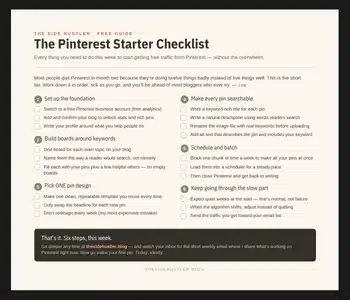
Download Your Free Pinterest Starter Checklist
Grab the free one-page checklist that shows you exactly what to do first, next, and after that.
