
Table of Contents

This post contains affiliate links. If you click through and buy something, I may earn a small commission — at no extra cost to you. I only recommend tools I’ve actually used or thoroughly researched.
When people search for “best print on demand sites” they’re usually trying to answer two different questions at once, which is why most roundup posts on this topic end up more confusing than helpful.
The two questions are: which supplier platform should I use to create and fulfill my products? And where should I actually sell them? These are different decisions, they involve different platforms, and they need to be answered separately.
This post does exactly that. By the end you’ll have a clear answer on both, plus a direct recommendation on the setup that works for most beginners.
The Two Decisions You Actually Need to Make
Before getting into the platforms, it’s worth being clear on what the two decisions actually are, because most people start researching without realizing they’re looking at two different types of tools.
Supplier platforms are the companies that print and ship your products. You upload your designs here, connect to your sales channel, and when an order comes in they handle printing and fulfillment automatically. You never touch the physical product. Examples: Printify, Printful, Gelato.
Sales channels are where customers find and buy your products. This could be a marketplace like Etsy, where buyers are already browsing and searching, or your own store on Shopify, where you control the branding and customer experience but you’re responsible for driving all your own traffic.
Most POD sellers use one supplier platform connected to one or two sales channels. The typical beginner setup is Printify connected to Etsy. Once you’ve got consistent sales and want more control, adding a Shopify store as a second channel makes sense. But that’s a second step, not a first one.

If you’re still getting your head around how the model works, the what is print on demand post covers the full concept before you dive into platform comparisons.
The Best Print on Demand Sites for Suppliers
These are the companies that will print and ship your products when orders come in.
Printify
Printify is where most beginners land, and for good reason. Free to start, one of the widest product catalogs in the POD space, and connects to Etsy and Shopify without any technical setup required.
The model is a network of third-party suppliers. You choose which supplier produces each product, and that choice matters. Different suppliers have different base costs, production times, and quality ratings. The best suppliers on Printify are excellent. The key is reading reviews and ordering samples before you commit to selling a product at volume.
Base costs are generally lower than Printful, which gives you more margin, particularly important when pricing competitively on Etsy. The free plan covers everything you need to start. The Premium plan unlocks up to 20% off base costs and runs $39 a month billed monthly, or $24.99 a month if you pay annually, worth it once you’re doing consistent volume.
For most beginners, Printify is the right starting point. Wide range, low costs, free to use, and straightforward to connect to Etsy. For the full comparison with Printful, the Printify vs Printful post covers every meaningful difference.
Printful
Printful owns and operates most of its own printing facilities, which means the quality and consistency are reliably high. What you see in the product preview is generally what your customer receives.
The trade-off is base costs. Printful’s prices are consistently higher than Printify’s, which squeezes your margin on every sale, particularly at the lower price points that tend to perform on Etsy. Those higher costs are easier to absorb once you’re selling premium products on your own store at higher price points.
Printful also has strong branding options, custom packaging inserts, branded labels, the details that matter when you’re building something recognizable. That’s where it earns its place.
Best for: established sellers building a branded store, anyone for whom consistent quality matters more than maximizing margin.
Gelato
Gelato is worth knowing about, particularly if you’re selling internationally. Their network of local print partners spans over 30 countries, which means products are typically printed close to the customer, resulting in faster shipping times and lower shipping costs.
The product range is solid, quality is generally good, and pricing is competitive. Less beginner-friendly than Printify in terms of interface and onboarding, but a strong option once you’re past the initial setup phase, especially if a significant portion of your customers are outside the US.
Gooten
Gooten operates on a similar model to Printify, a network of third-party suppliers with a range of products and varying base costs. The catalog is smaller and the interface is less polished, which makes it a harder starting point for beginners.
Where Gooten occasionally wins is on specific product categories or pricing for particular niches. Worth knowing it exists, but not the right first choice for most people starting out.
Quick Comparison: Supplier Platforms
| Printify | Printful | Gelato | Gooten | |
|---|---|---|---|---|
| Free plan | Yes | Yes | Yes | Yes |
| Base costs | Low | Higher | Competitive | Varies |
| Product range | Very wide | Curated | Good | Moderate |
| Print quality | Varies by supplier | Consistently high | Generally good | Varies |
| Best for | Beginners, Etsy sellers | Branded stores, premium | International sellers | Specific niches |

The Best Sales Channels for Print on Demand
Where your customers will actually find and buy your products.
Etsy
Etsy is the recommended starting point for most POD beginners, and not just because it’s popular. The reason it works so well for print on demand is buyer intent. People don’t browse Etsy the way they browse social media, they arrive looking for something specific. A personalized gift. A niche mug. A piece of wall art for a spare room. That intent is worth an enormous amount when you’re a new shop with no existing audience.
Etsy’s internal search also gives you discoverability without a marketing budget. Get your listings right, strong titles, all 13 tags used, good mockup images, and Etsy will surface your products to buyers already looking for them.
The costs are real and worth factoring into your pricing: $0.20 per listing, 6.5% transaction fee on each sale, and payment processing on top (about 3% + $0.25 for US sellers). And you’re building on someone else’s platform, subject to their rules and algorithm changes.
But for a beginner without an existing audience, there’s no faster path to a first sale than a well-optimized Etsy listing. Start selling on Etsy and build from there.
For the full Etsy setup walkthrough, the print on demand on Etsy guide covers every step from account creation to your first published listing.
Shopify
Shopify is the scale-up option, the platform to move to once you have consistent Etsy income and want more control over your brand and better long-term margins.
The advantages are real: you own the customer relationship, there’s no per-sale transaction fee to a marketplace, and you can build a branded experience that’s difficult on Etsy. You can also run email marketing, retargeting, and loyalty programs in ways Etsy’s structure doesn’t allow.
The significant trade-off is traffic. On Etsy, buyers come to you. On Shopify, you’re responsible for every visitor to your store, which requires a traffic strategy that most beginners aren’t ready to execute before they’ve validated their niche and products.
For most people, Shopify makes sense as a second channel, not a first one. Add it once you know what’s selling, who’s buying, and how to reach them. The how to start a Shopify store guide covers the setup in detail.
Amazon Merch on Demand
Amazon’s own POD program, now officially called Amazon Merch on Demand, is worth knowing about. The traffic potential is enormous and buyer trust is high. But it’s not a beginner’s first move.
The program is invitation-only, you apply and wait to be accepted, which can take weeks or months. Design guidelines are strict. Amazon also overhauled its royalty structure in June 2026, moving from a flat rate to a three-tier system (Creator, Plus, Premium), where which tier you’re on depends on how much of your traffic comes from outside Amazon rather than Amazon’s own search. The base Creator tier pays noticeably less than the old flat rate did, a standard t-shirt nets around $2.44 at Creator level, rising toward $5 or more at the higher tiers if you’re driving your own traffic in. Worth knowing this is a recent, meaningful change before you apply, rather than assuming the flatter “few dollars a sale” picture older guides describe still holds.
Once you’re established with a catalog of proven designs, Amazon Merch is worth applying for. But it’s a supplementary channel, not a starting point. The Merch by Amazon guide covers how it works and how to apply, and once those royalties start landing, Amazon FBA taxes walks through the 1099-K and quarterly payment side (the cost of goods sold parts of that post are for inventory-based FBA selling and won’t apply to Merch royalties, but the reporting mechanics do).
Redbubble and Society6
These marketplace platforms handle everything, printing, shipping, customer service, and driving traffic to your products. No store setup, no marketing required on your part.
The catch is margin. Both platforms take the vast majority of each sale, leaving you a small royalty percentage. You also have very limited control over how your products are presented and priced.
Most serious POD sellers use these as a supplementary income stream, uploading existing designs for passive discovery, rather than building their primary business here. Worth knowing about, not worth prioritizing over Etsy or Shopify.
Quick Comparison: Sales Channels
| Etsy | Shopify | Amazon Merch | Redbubble | |
|---|---|---|---|---|
| Setup difficulty | Low | Medium | Low (if accepted) | Very low |
| Traffic source | Built-in marketplace | Self-generated | Built-in marketplace | Built-in marketplace |
| Fees | Listing + transaction | Monthly subscription | None upfront | None upfront |
| Margin potential | Good | Best | Lower royalties | Very low |
| Best for | Beginners, niche products | Established sellers | Supplement channel | Passive discovery |
The Setup That Works for Most Beginners
Here’s the straight answer.

Start with Printify as your supplier and Etsy as your sales channel. Free to start on both, built-in traffic from Etsy, manageable fees, and a wide product range to test and learn without hitting limitations.
Get consistent Etsy sales first, not occasional sales, but reliable monthly revenue. Once you’re there, adding Shopify as a second channel gives you more control and better margins as you scale. Trying to shortcut this by starting with Shopify usually means spending money on a store without the traffic to justify it.
Consider switching to or adding Printful when consistent quality and branding options matter more than maximizing margin per sale. It’s not a beginner’s platform, it’s for sellers who’ve proved the model and are building something with longevity.
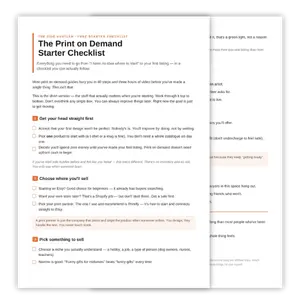
Download Your Free Print on Demand Starter Checklist
The two-page checklist that takes you from ‘no idea where to start’ to your first live listing — yours the second you sign up.
Common Setup Mistakes to Avoid
Three things worth knowing before you start.
Signing up to multiple supplier platforms before mastering one. The platforms are similar enough that switching between them before you’ve got any traction just adds confusion. Pick Printify, learn it properly, and look elsewhere only if you hit a specific limitation it can’t solve.
Choosing Shopify before you have any sales. A well-designed Shopify store with no traffic is just an expensive monthly subscription. Etsy first, always. Build the sales history and product knowledge before investing in your own store.
Ignoring Etsy’s fees when pricing. The listing fee, transaction fee, and payment processing together take more from each sale than most beginners expect. Run the numbers before you set a price. The print on demand on Etsy post has a concrete pricing example worth reading before you publish anything.
Ready to Set Up?
The platform decision is straightforward for most beginners. Printify for the supplier, Etsy for the sales channel. Both are free to start, both integrate cleanly, and together they give you everything you need to get your first product live.
Set up your free Printify account and connect it to your Etsy shop. For the full step-by-step walkthrough, from account setup to first listing published, the print on demand side hustle guide covers the whole process from the beginning.
