
Table of Contents

This post contains affiliate links. If you click through and buy something, I may earn a small commission at no extra cost to you. I only recommend tools I have used or thoroughly researched.
Print on demand sounds almost too convenient: create a design, list it on a product, and let someone else print and ship it when it sells. That part is real. What gets left out is that print on demand is not an easy-money shortcut, and it is not passive when you are starting from zero.
So, is print on demand worth it in 2026? It can be, especially if you want a low-upfront-cost way to build a product business without buying inventory. But it only makes sense if you are willing to learn a niche, make products people really want, and improve your listings over time.
This is a decision guide, not a setup tutorial. It will help you understand what print on demand is good for, where it disappoints people, what it costs, and, ultimately, whether print on demand is a good side hustle for you specifically.
A quick note on where I’m coming from: I haven’t started a print on demand shop myself. Between the blog and building out my Etsy printables shop, I don’t have the hours in the day for a third product line right now, it’s on my list for when things ease up. So this is a decision guide built from research and from watching how real POD sellers talk about the model, not a report from my own shop. I think that’s still worth something. I’m not trying to sell you on something I haven’t tested myself.
The short answer: is print on demand worth it?
If the question on your mind is simply should I start print on demand, here’s the short version:
Print on demand is worth considering if you want to sell physical products without holding stock, can work patiently, and are prepared to treat product research and marketing as part of the job.
It is probably not worth it if you need reliable income quickly, dislike creating and testing product ideas, or expect a few generic designs to produce automatic sales.
The business model removes three real barriers: you do not need to buy products in bulk, pack orders at home, or arrange shipping. It does not remove the work of choosing an audience, creating products, writing listings, serving customers, and getting found.
Print on demand may suit you if…
- You can give a small business several months to develop.
- You enjoy finding specific audiences, occasions, or interests to serve.
- You want to sell products without storing inventory.
- You are happy to learn basic listing SEO, design, and customer service.
It may not suit you if…
- You need predictable income in the next few weeks.
- You only want to upload broad slogan designs and wait for traffic.
- You want full control over production speed, packaging, and quality.
- You want a completely hands-off income stream from day one.
What print on demand gives you
Print on demand lets you sell a product before it exists physically. You create a design, add it to a product such as a t-shirt, mug, tote bag, poster, or notebook, and publish a listing through a sales channel. When a customer orders, a supplier prints the item and sends it to them.
Not every product works equally well for this. Some formats sell far more easily than others, and if you’re not sure where to start, this roundup of best print on demand products for beginners breaks down which items are easiest to get right first.
The important benefit is not that the work disappears. It is that you avoid putting money into inventory that may never sell. You pay the supplier only after a sale, so you can test product ideas without filling a spare room with boxes.
Who benefits most from the model?
- The beginner learning ecommerce: You can learn listings, product positioning, margins, and customer demand without committing to a wholesale order.
- The niche seller: You can create products for a specific hobby, job, life event, relationship, or community that a large retailer would not target well.
- The creator with an audience: If you already have readers, subscribers, followers, or a community, POD can turn a small part of that attention into relevant products.
It is less attractive if your main advantage is being cheaper than everyone else. Print-on-demand unit costs are usually higher than bulk-manufactured products, so competing on the lowest price is difficult. Your advantage needs to be relevance, originality, a clear niche, a better product idea, or an audience that trusts you.
The costs people forget to include
How much does it cost to start print on demand? You can usually open a supplier account for free, and you do not have to pay for stock upfront. That does not mean the business is cost-free. If you haven’t picked a platform yet, this comparison of best print on demand sites is worth reading before you commit to one.
- Marketplace fees: Listing, transaction, and payment-processing fees when you sell through a marketplace (Etsy and Merch by Amazon print on demand both handle this a little differently, worth checking before you commit to one).
- Supplier base cost: The blank product, printing, and sometimes shipping.
- Samples: Optional at the beginning, but one of the best ways to check print quality, sizing, packaging, and delivery expectations.
- Design tools or assets: Free tools can be enough to begin, but only use fonts, graphics, and templates with a license that allows commercial use. If you want a free way to start, you can use Canva for print on demand designs before investing in anything paid.
- Refunds and replacements: A damaged, delayed, or misprinted order is still your customer-service problem, even when a supplier made the item.
- Your time: Product research, mock-ups, listing copy, customer messages, and testing are part of the cost.
Do the margin calculation before publishing a product. Start with the selling price, then subtract supplier cost, any shipping contribution, marketplace fees, payment fees, advertising spend if applicable, and an allowance for problems. If the remaining amount is too small to justify the work, change the product, price, or positioning before building a large catalog.
The biggest reason new POD shops do not sell
Most new shops do not fail because the owner chose the wrong supplier. They fail because the products are too generic to give shoppers a reason to choose them.
A phrase on a t-shirt is not automatically a niche. “Dog lover” is broad. “Retired emergency nurse who spoils her dachshund” is far more specific. The goal is not to make a design for everybody; it is to make a gift or product that feels unusually relevant to somebody. If you’re not sure where to look, here’s how to choose a print on demand niche that has room for you in it.
Before creating a product, ask:
- Who is this for?
- What moment, identity, problem, hobby, job, or relationship makes it relevant?
- Would that person search for it, save it, or buy it as a gift?
- Can I create several related products for the same audience without repeating myself?
- Can I describe the product accurately without using someone else’s trademark, copyrighted character, logo, or protected phrase?
If you’re not sure where that line sits, the USPTO’s trademark basics page is a solid, free starting point before you build a whole niche around something that isn’t yours to use.
Once you know who you’re designing for, the actual design work is where most of that niche gets translated into something sellable. If you want the specifics, here’s how to create print on demand designs that fit a niche instead of just filling a template.
A smaller collection of well-targeted products is a better starting point than a large catalog of interchangeable quotes.
Is print on demand passive income?
No, not at the beginning.
A listed product can keep selling without you remaking it each time, so POD can grow beyond your hours in a way a service business can’t, where you trade every hour directly for money. But the early work is active: learning the market, creating products, improving titles and images, answering questions, and resolving order issues.
Over time, a well-organized catalog can become more efficient. You learn which product types, niches, seasons, and listing formats work for your shop. That is different from passive income; it is a business that can become less dependent on daily manual fulfillment.
Print on demand versus dropshipping
Both models avoid holding inventory, but they are not identical. With standard dropshipping, you typically resell an existing product from a supplier. With print on demand, your design or customization is applied after the order is placed.
That distinction matters because a POD product needs a reason to exist beyond being available cheaply elsewhere. Your design, niche knowledge, product selection, and listing presentation are the value you add.
When you should choose something else
Choose another side hustle first if you need cash flow quickly. A service such as virtual assistance, freelance writing, bookkeeping, tutoring, or local work can often produce income sooner because you are selling a skill directly rather than waiting for product discovery.
You may also prefer digital downloads if you enjoy creating templates, planners, printables, or guides. They do not have shipping delays, physical defects, supplier changes, or per-order production costs. They come with their own challenges, mainly standing out and driving traffic, but are often simpler operationally. If that sounds closer to what you want, here’s how to sell printables online instead.
A practical way to test whether POD is for you
Do not begin by building a 100-product shop. Run a small, deliberate test instead.
- Pick one narrow audience or occasion. Avoid a broad category such as “fitness” or “moms.” Choose a clear angle you can understand and serve.
- Research the existing market. Look at how people describe products, which formats appear repeatedly, what buyers mention in reviews, and where there may be room for a clearer offer.
- Create a small collection. Build a handful of related designs or products rather than one random listing.
- Check your rights and margins. Confirm every font, graphic, phrase, and asset is safe for commercial use. Calculate the margin for each product before it goes live. If you haven’t picked a supplier yet, this Printify vs Printful comparison breaks down how their pricing and margins differ.
- Order a sample when you can. Check the item as a customer would, including print quality and how it arrives.
- Set a review point. Give the experiment a defined period, then assess impressions, clicks, favorites, questions, conversions, and the work you enjoyed or disliked.
You do not need to prove that POD works for everyone. You need to find out whether it works for your skills, your niche, and the time you can realistically give it.
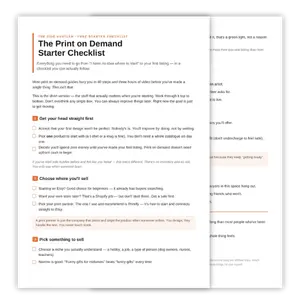
Download Your Free Print on Demand Starter Checklist
The two-page checklist that takes you from ‘no idea where to start’ to your first live listing — yours the second you sign up.
Final verdict
Print on demand is worth starting if you see it as a low-inventory product business, not a shortcut to passive income. Its best feature is not that it makes ecommerce effortless; it is that it lets you test a focused product idea without paying for stock upfront.
Start if you can be patient, think in niches, check your numbers, and improve based on evidence. Skip it, or keep it as a later project, if you need immediate income or want a business with no customer-service, marketing, or creative work.
If you’ve read this far and it still sounds like a fit, the practical next step is starting a print on demand side hustle, which covers account setup and getting your first listing live. Keep this article as your reference for whether POD is worth your time in the first place; use that one for the how.
Planning to sell specifically on Etsy? There’s a dedicated walkthrough for how to sell print on demand on Etsy that covers the platform-specific setup this guide doesn’t.
