
Table of Contents

This post contains affiliate links. If you click through and buy something, I may earn a small commission — at no extra cost to you. I only recommend tools I’ve actually used or thoroughly researched.
The question most people are really asking when they search for print on demand isn’t “how does it work.” It’s “can I actually make money from this, and if so, how much, and how long does it take?”
Those are the right questions. And they deserve straight answers rather than income screenshots and vague promises about passive income.
So here’s the honest version of how to make money with print on demand. It’s a real income stream, not instant, not passive from day one, and it rewards people who treat it like a business rather than a lottery ticket. But it works, and this post covers exactly what that looks like in practice.
Can You Actually Make Money with Print on Demand?
Yes. But the income curve looks nothing like most people expect.
The reality for most beginners is a slow start, weeks of low traffic, maybe no sales, a lot of wondering whether anything is working. Then, gradually, momentum. A few sales. Then more consistent sales. Then, if you’ve built the right foundations, something that starts to feel like a real income stream.
At a part-time side hustle level, a few hours a week, 30–50 well-chosen products, consistent effort over several months, $300–$1,000 a month is an achievable range. That’s not life-changing on its own, but it’s a meaningful contribution to a household income and a proof of concept worth building on.
At the other end of the scale, the model is capable of producing serious numbers. Emily, a coach at Gold City Ventures, reports over $800,000 in Etsy sales across her two shops, mostly from print on demand, built around a repeatable strategy of giftable products executed consistently. Those are her own figures, not a typical result, and not a promise you’ll match them. But they show the model can work at scale when it’s approached properly.
The shops that fail, and plenty do, tend to share the same characteristics. No clear niche. Generic designs. A handful of listings. Three months of silence followed by giving up. The ones that succeed do the opposite: they pick a specific audience, list consistently, get their SEO right, and keep going when nothing seems to be happening yet.
If you’re still getting your head around how the model works before thinking about income strategy, the print on demand side hustle guide covers the full picture.
How Print on Demand Income Actually Works
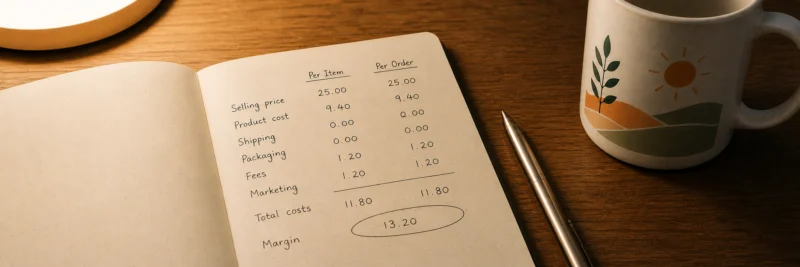
Before getting into strategy, it’s worth understanding the mechanics, because income in POD is margin multiplied by volume, and both are in your control.
Margin is the difference between what you sell a product for and what it costs to produce and ship, after Etsy’s fees. On a mug selling for $19, you might pay $9 in base costs and $2 in Etsy fees, leaving you $8. That’s your margin per sale.
Volume is how many of those sales happen. And volume in POD is largely a function of how many listings you have, how well those listings are optimized, and how much traffic you’re driving to your shop.
Put those two things together and the income picture becomes concrete. A shop with 50 products averaging 3 sales per day at $8 margin each is making around $720 a month. That same shop at 100 products, with better SEO and a Pinterest presence driving external traffic, might look at double that, or more during seasonal spikes around Christmas and gifting occasions.
The reason income feels slow at first is that Etsy’s algorithm needs time to understand your shop and match your products to the right buyers. That process takes weeks, sometimes months. It’s not a reflection of whether your products are good, it’s just how the platform works. And once it starts moving, it tends to compound rather than plateau.
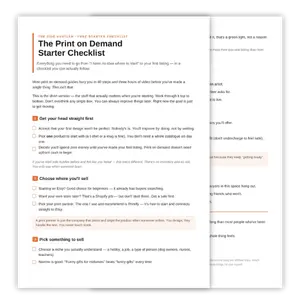
Download Your Free Print on Demand Starter Checklist
The two-page checklist that takes you from ‘no idea where to start’ to your first live listing — yours the second you sign up.
The 5 Things That Separate POD Shops That Earn from Ones That Don’t

This is the part that actually determines whether a POD shop makes money. Not the platform, not the design tools, not the price point. These five things.
1. They Picked a Niche and Stuck to It
A shop that sells funny dog mugs, motivational gym t-shirts, and kids’ birthday ornaments has no identity. The Etsy algorithm doesn’t know who to show it to. Buyers who land on it don’t feel like it was made for them. And the shop owner has no clear direction for what to create next.
Niche shops work because they build an audience. A shop that only serves dachshund owners becomes the dachshund shop. Buyers come back. They tell their friends. The algorithm learns who to surface it to. Everything gets easier once the niche is clear.
If you haven’t decided what to sell yet, the best print on demand products post covers ten categories with strong niche potential and honest notes on margin and demand.
2. They Focused on Giftable Products
The biggest revenue spikes in print on demand don’t come from people buying things for themselves. They come from people buying gifts, for birthdays, Christmas, Mother’s Day, Father’s Day, Valentine’s Day, and every other occasion where someone needs something specific and personal.
Shops that lean into the gifting angle consistently outperform those that don’t. Products that feel like they were made for a specific type of person, listed in a way that helps gift-buyers find them, that combination drives sales in a way that general products rarely do.
This is the core insight behind the Gifting Gold free workshop from Gold City Ventures. Emily reports that giftable seasonal products drove most of her $800,000+ in Etsy sales across two shops, her own figures, not a typical result, and the workshop walks through exactly how she approaches product selection and shop positioning. It’s free and worth an hour of your time before you decide what to focus on.
3. They Listed Consistently, Not in Bursts
One of the most common patterns in failed POD shops goes like this: someone spends a weekend creating 10 listings, sees no sales after two weeks, and stops. The shop sits dormant. Nothing happens.
The shops that build momentum list consistently, a few new products every week. Not because every listing is a winner, but because each one is another entry point into Etsy’s search results. Volume creates surface area. Surface area creates traffic. Traffic creates sales.
Thirty products listed steadily over three months will outperform ten brilliant listings created in a single burst, every time.
4. They Got Their Listings Right
A great design in a poorly optimized listing will not sell. The title, tags, and mockup images determine whether Etsy shows your product to the right buyer, and whether that buyer clicks through when they see it.
Strong titles match how buyers actually search. All 13 tags are used, covering different angles a buyer might search from. The first listing image is a lifestyle mockup, not a flat design preview on a white background.
Getting those three things right from the start is one of the highest-leverage things you can do for a new POD shop. The print on demand on Etsy guide covers the full listing process, including a concrete pricing example worth reading before you publish anything.
5. They Drove Traffic from Outside Etsy
Etsy’s internal search is not enough on its own for a new shop with no sales history and no reviews. The algorithm favors shops that already have traction, which creates a catch-22 for beginners.
The way out is external traffic. And for most POD sellers, Pinterest is the highest-leverage channel available. Pins drive traffic directly to listings, and unlike Etsy’s algorithm, Pinterest doesn’t penalize new accounts for being new. A well-made pin for a niche product can drive consistent traffic for months.
The how to market printables on Pinterest post covers the Pinterest traffic strategy in detail, and while it’s written around printables, every principle translates directly to POD products.
How to Make Money with Print on Demand: Your First $100

The first milestone worth aiming for isn’t $10k a month. It’s $100. Not because $100 is the goal, but because making your first $100 proves the model works, and that changes how you think about the whole thing.
Here’s the approach.
Pick one product and one niche. Not five products and three niches, one of each. A mug for dachshund owners. A tote bag for elementary school teachers. A hoodie for people who love hiking. Something specific enough that a buyer sees it and thinks: that’s for me.
Create 5–10 designs for that niche. They don’t need to be masterpieces. They need to be relevant, readable, and better than generic. A few hours in Canva, the free version is enough to start.
List each product with a strong title, all 13 tags used, and at least five lifestyle mockup images. Don’t skip the mockups, they’re the difference between a listing that converts and one that doesn’t.
Push one Pinterest pin per listing. Simple pin, clear hook, links directly to the listing.
Then give it 30 days. Not 30 days of checking the dashboard every hour, 30 days of consistent listing and pinning, followed by an honest look at what’s getting views and what’s getting sales.
That’s the proof-of-concept stage. Once you’ve made $100, you know the model works for your niche. Everything after that is scaling what’s already working.
How to Scale Print on Demand Income Beyond the First Sales
Once the proof of concept is there, the path forward is simpler than most people expect.
Add more designs in the same niche. Not a new niche, the same one. You’ve already proved it works. Double down before branching out. More designs means more listings means more surface area on Etsy and more content for Pinterest.
Expand to a second product type in the same niche. If mugs are working, create the tote bag version of your best-selling designs. If t-shirts are selling, try hoodies in the same style. Same audience, more products, higher chance of being found and a higher average order if buyers purchase more than one item.
Build your Pinterest presence over time. Pins compound in a way that Etsy listings alone don’t. A pin published six months ago can still be driving traffic today. The earlier you start, the more that effect works in your favor.
Once you’re seeing consistent Etsy income, not occasional sales but reliable monthly revenue, that’s when to think about a second sales channel. A Shopify store gives you more control and better long-term margins. But it’s a second step, not a first one.
If you’re doing enough volume that base costs are a real concern, Printify’s Premium plan is worth a look. It’s $24.99 a month on annual billing ($299 a year), or $39 month to month, and the up to 20% discount on base costs pays for itself quickly once you’re moving consistent stock.
What to Expect in the First 90 Days

Most people who quit print on demand do it in the first 90 days. Usually because nothing seemed to be working, and because they didn’t know that nothing seeming to work in the first 90 days is completely normal.
Here’s what those 90 days actually look like.
Month one is setup and early listings. Traffic is minimal. Sales are rare or nonexistent. The Etsy algorithm is just beginning to understand what your shop sells and who it’s for. This is not the time to evaluate whether it’s working, it’s too early. Keep listing.
Month two is when Etsy starts properly indexing your listings and showing them to buyers. You’ll start to see views. Some listings will get traction, most won’t. First sales often happen here, not consistently, but enough to show the model is working. Pay attention to which listings are getting seen and which are converting.
Month three is when patterns emerge. You’ll have a clearer picture of which products and designs your audience responds to. This is when most successful sellers double down on what’s working and quietly retire what isn’t.
The 90-day period is a learning phase, not a proving phase. The goal isn’t to make serious money in 90 days, it’s to understand your audience well enough to scale what works in month four and beyond.
The Tools Worth Using
Three tools. Nothing more complicated than this.
Printify: the platform. Free to start, connects to Etsy cleanly, wide product catalog, and a supplier network that lets you find printers close to your target market. Where most beginners should start.
Canva: designs. The free version covers text-based layouts, simple illustrations, and typographic designs across most POD product categories. You don’t need the paid plan to get going.
Gifting Gold free workshop: strategy. A structured approach to building a profitable POD shop from a coach who’s built a high-earning Etsy business. Worth an hour of your time before you decide what to focus on.
Ready to Start?
Print on demand income is real, it just doesn’t arrive on a schedule, and it doesn’t arrive without the work. The shops making consistent money are the ones that treated it like a business from day one, kept going when nothing seemed to be happening, and doubled down on what worked once they found it.
The first step is the same for everyone: set up a free Printify account, pick one product, pick one niche, and list something this week.
If you want the full setup walkthrough for selling on Etsy, the print on demand on Etsy guide covers every step from account creation to your first published listing.