
Table of Contents

This post contains affiliate links. If you click through and buy something, I may earn a small commission, at no extra cost to you. I only recommend tools I’ve actually used or thoroughly researched.
If you want to market printables on Pinterest, you’re looking at the single best free traffic source for printable sellers. And I’m not just saying that from research, I’ve been using Pinterest for over two years to drive traffic to this blog, and I’ve seen firsthand how well it works as a visual search engine.
Here’s why the combination works so well: Pinterest is where people go to search for ideas, plan projects, and find solutions. Printables are ideas, projects, and solutions in a downloadable format. The buyer intent overlap is almost perfect.
A well-designed pin linking to your Etsy listing can drive consistent traffic for months, sometimes years, without any additional effort from you. That’s the kind of marketing channel that makes sense for a printable seller who doesn’t want to spend all day on social media.
Recommended reading: For the full picture of selling printables as a business, start with How to Sell Printables Online.
Why Pinterest Works So Well for Printables
Most social media platforms show your content once, and then it disappears. You post on Instagram, it gets some engagement for a day or two, and then it’s gone. Pinterest is different. Pins have a shelf life of months, not hours. A pin you create today can still be driving traffic to your Etsy listing six months from now.
That’s because Pinterest functions as a search engine, not a social feed. People type in what they’re looking for, “budget planner printable,” “meal plan template,” “nursery wall art”, and Pinterest shows them results. If your pin matches what they’re searching for, it shows up. Repeatedly. Over time.
And printables are one of the most popular content categories on Pinterest. People actively search for planners, trackers, worksheets, wall art, and templates on the platform every single day. You’re not trying to convince people they need your product, they’re already looking for it.
Recommended reading: Pinterest for Bloggers, my full guide to using Pinterest as a traffic source.
How to Market Printables on Pinterest: Step by Step
Step 1: Set Up a Pinterest Business Account
If you haven’t already, convert your Pinterest account to a Pinterest business account (or create one from scratch). It’s free and takes a few minutes. A business account gives you access to Pinterest Analytics, which you’ll need to see what’s working.
Claim your Etsy shop URL so Pinterest knows your pins link to your shop. This also helps your pins get prioritized in search results related to your products.
Step 2: Create Boards That Match Your Niche
Set up boards that align with the printable categories you sell. If you sell budget planners, create boards like “Budget Planning Tips,” “Personal Finance Printables,” and “Saving Money Ideas.” If you sell wall art, try “Printable Wall Art,” “Nursery Decor Ideas,” and “Home Office Inspiration.”
Each board should have a clear, keyword-rich title and description. Pinterest uses these to understand what your board is about and which search queries to show your pins for.
Don’t create 30 boards on day one. Start with 5–8 focused boards that are directly relevant to your products and the topics your target buyers care about.
Recommended reading: Pinterest Keyword Research, how to find the right keywords for your boards and pins.
Step 3: Design Pins That Get Clicked
This is the most important step. Your pin is the ad for your product, it’s what stops someone mid-scroll and makes them want to learn more.
For printable sellers, the most effective pin designs tend to include a clear product image (your printable shown in a mockup or lifestyle setting), a text overlay that tells the viewer exactly what the product is, and clean, on-brand colors that match your shop’s style.
Vertical pins perform best on Pinterest, the standard recommended size is 1000 x 1500 pixels (2:3 ratio). You can create these in Canva using Pinterest pin templates.
A few things I’ve learned from my own Pinterest experience:
Your pin image needs to be readable on a mobile screen. Most Pinterest users browse on their phones, so small text and cluttered designs get scrolled past. Keep it clean, keep the text large, and make sure the product is the focus.
Create 2–3 different pin designs for each Etsy listing. Each pin is a separate chance to appear in search results. Different designs might appeal to different searchers, and testing variations is how you find what resonates with your audience.
Recommended reading: Pinterest Pin Design, the principles of creating pins people click.
Step 4: Write Pin Descriptions With Keywords
Every pin needs a description that includes the keywords your target buyers are searching for. This isn’t about stuffing keywords, it’s about writing a natural sentence or two that describes your product and includes the terms people use to find it.
For a budget planner printable, your description might be something like: “A simple monthly budget planner printable to help you track income, expenses, and savings goals. Download instantly and start planning today. Perfect for beginners.”
Use Pinterest’s search bar to research which keywords are popular. Type in your product type and look at the suggested searches that appear, those are the exact phrases real people are typing.
Recommended reading: Pinterest SEO for Beginners, how to get your pins found in Pinterest search.
Step 5: Pin Consistently
You don’t need to pin 50 times a day. I’ve found consistency matters more than volume. Pinning a few fresh pins every day beats pinning 30 things once a week and then going silent.
Use a scheduler to queue your pins in advance so you’re not on Pinterest every single day. I started out with Tailwind when I was new, it’s great for beginners and makes staying consistent easy. I still dip into it now and then, but these days I mostly use Buffer, because it lets me handle my other social platforms from the same calendar. Either one takes the daily pressure off.
For a new printable shop, I’d aim for 3–5 fresh pins per day. That’s a mix of your own product pins and repins of relevant content from other creators in your niche. Over time, you’ll build a library of pins that continue to work for you passively.
Step 6: Link Your Pins Directly to Your Etsy Listings
Every pin for a specific product should link directly to that product’s Etsy listing, not to your shop homepage, not to a blog post, not to a landing page. The buyer searched for a budget planner, saw your pin, clicked on it, they want to land on the budget planner they just saw. Any extra steps between the click and the product page is where you lose people.
Make sure the Etsy listing image and the pin image are consistent. If someone clicks a pin showing a green minimalist planner and lands on a listing with a completely different design, they’ll bounce. Visual continuity builds trust.
How Long Does It Take to See Results?
I’ll be honest with you, Pinterest isn’t instant. When I first started using it for this blog, I had a bit of traffic early on, but it took a couple of months before it felt meaningful. There were spikes and dips along the way, and it felt slow at first.
But once it started working, it kept working. That’s the trade-off. Pinterest rewards patience and consistency. The pins you create this month will still be driving traffic three, six, twelve months from now.
For a printable seller, I’d expect to start seeing some traffic within 2–4 weeks of consistent pinning, with meaningful results building over the first 2–3 months. The sellers who stick with it are the ones who see the compounding effect, each new pin adds another entry point, and the traffic builds over time.
Common Pinterest Mistakes Printable Sellers Make
Not using keywords. If your pin descriptions and board titles don’t include the words buyers search for, Pinterest can’t match your content to the right audience. Keywords are how you get found.
Pinning the same image over and over. Create multiple pin designs for each product. Pinterest wants fresh content. Posting the same pin repeatedly can reduce your reach.
Ignoring analytics. Check your Pinterest Analytics regularly. See which pins are getting the most impressions, clicks, and saves. That data tells you what’s working so you can create more of it.
Treating Pinterest like Instagram. Pinterest isn’t about followers or engagement in the traditional social media sense. It’s a search engine. Focus on creating discoverable content, not building a following.
Free Pinterest Training Workshop
Content ideas are only useful if your Pinterest strategy is solid enough to make them work. Meagan Williamson’s free workshop — The Discovery Loop — covers the full system so your content gets found.
Bringing It All Together
Pinterest and Etsy printables are a natural fit. Pinterest brings the traffic, Etsy handles the sale and delivery, and your printable earns you money on both ends without any ongoing work per sale.
If I were starting a printable shop today, I’d be pinning from day one. Not next month, not after I have “enough” listings. Day one. The sooner you start building your Pinterest presence, the sooner the traffic starts flowing.
Recommended reading: How to Sell Printables on Etsy, make sure your Etsy listings are ready to convert the traffic Pinterest sends you.
Recommended reading: How to Scale Your Printables Business, once Pinterest traffic is flowing, here’s how to build on it.
Marketing printables on Pinterest runs on the same fundamentals as everything else, get those right and the sales follow. The free Pinterest Starter Checklist below has them on one page. Grab it and get going.
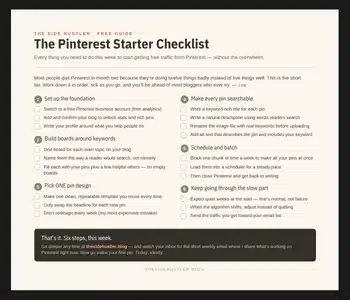
Download Your Free Pinterest Starter Checklist
Grab the free one-page checklist that shows you exactly what to do first, next, and after that.
