
Table of Contents

This post contains affiliate links. If you click through and buy something, I may earn a small commission, at no extra cost to you. I only recommend tools I’ve actually used or thoroughly researched.
If you’ve made your first few sales selling printables and you’re wondering what comes next, this post is for you. Getting that first sale is the hardest part, it proves the model works. Now the question is how to scale your printables business from a handful of sales into a consistent income stream, growing your Etsy printables shop into something that pays reliably every month.
The good news is that scaling printables is very different from scaling a physical product business. You don’t need more inventory, more staff, or more warehouse space. You need more listings, better listings, and smarter traffic. That’s it.
Here’s how to do it, step by step.
Recommended reading: If you haven’t made your first sale yet, start with How to Sell Printables Online.
Double Down on What’s Already Selling
This is the simplest and most effective scaling strategy, and most sellers overlook it.
Look at your Etsy stats. Which products are getting the most views? Which ones are converting to sales? Which ones have the best reviews? Those are your winners, and they’re telling you exactly what your audience wants more of.
If your monthly budget planner is your best seller, create variations. A weekly version. A bi-weekly paycheck version. A version for couples. A version for students. A minimalist version. A colorful version. Each variation is a new listing that targets a slightly different search term while building on a product concept you already know works.
This approach is more reliable than guessing what new product to create next. You’re not starting from scratch, you’re expanding on proven demand, which is the safest way to scale your printables business without wasting time on ideas that may not land.
Build Product Bundles to Scale Your Printables Business
Bundling is one of the fastest ways to increase your average order value.
Take 3–5 related printables and package them together at a price that’s lower than buying each one individually, but higher than any single product. If your individual budget trackers sell for $5–$7 each, a “Complete Budget Planning Bundle” with five trackers at $18–$20 gives the buyer a deal and gives you a much larger sale from one transaction.
Bundles also perform well in Etsy search because they often have higher engagement metrics. Buyers who spend more tend to be more invested, they’re more likely to leave a review, which helps your ranking.
Create bundles around themes, seasons, or buyer personas. A “New Year Planning Bundle,” a “Wedding Day Printable Set,” or a “Small Business Starter Pack”, these feel curated and intentional, not random.
Recommended reading: How to Price Printables on Etsy, pricing strategy for individual products and bundles.
Grow Your Listing Count With Intention
More listings means more entry points in Etsy search. That fundamental hasn’t changed. But in 2026, the quality of each listing matters as much as the total number.
Set a realistic publishing schedule. Adding 2–3 new listings per week is sustainable for most sellers and gives you a steady flow of fresh content for Etsy’s algorithm. Over three months, that’s 24–36 new listings, a real expansion of your shop.
But don’t create products just to hit a number. Every new listing should be based on research: what are buyers searching for in your niche that you don’t currently offer? What gaps exist in your product line? What seasonal products should you be preparing for?
The sellers who scale successfully treat their product creation like a content calendar. They know what’s coming next, they plan for seasonal demand, and they create with intention rather than scrambling to fill space.
Recommended reading: If I Were Starting an Etsy Printables Shop Today, the planning approach that sets you up to grow your Etsy printables shop from the start.
Improve Your Existing Listings
Scaling isn’t just about adding new products. It’s also about making your existing listings perform better.
Go back through your current listings and ask yourself honestly: are the mockup images as strong as they could be? Is the title clear and natural (not keyword-stuffed)? Does the description explain everything a buyer needs to know? Are all 13 tags filled out with relevant search phrases? Are the attributes complete?
Etsy’s Search Visibility dashboard now tells you which of your listings have reduced visibility and why. Check it regularly. If a listing is being held back because of a cluttered title or poor image quality, that’s a quick fix with an immediate impact.
Small improvements across 20–30 existing listings can often drive more additional revenue than creating 5 brand new products. And it takes less time.
Drive External Traffic With Pinterest
If you’re not already using Pinterest to drive traffic to your Etsy shop, this is the single biggest growth lever available to you.
Pinterest is a visual search engine, and printables are one of the most popular categories on the platform. A well-designed pin linking to your Etsy listing can drive consistent traffic for months without any ongoing effort. And unlike Etsy Ads, it’s completely free.
I’ve been using Pinterest for over two years to drive traffic to this blog, and the traffic compounds over time. The pins you create this month will still be bringing visitors three, six, twelve months from now. For a printable seller, that means every pin you post is a long-term investment in your shop’s traffic, and steady, compounding traffic is where real printables business growth comes from.
Recommended reading: How to Market Printables on Pinterest, the full strategy for connecting your Etsy shop to Pinterest.
Raise Your Prices as You Grow
Most sellers start with prices that are too low and never raise them. As your shop builds reviews, your listing quality improves, and your brand becomes more recognizable, your prices should go up too.
Test price increases gradually. If a product is selling consistently at $6, try $7. If sales hold steady, try $8. You might lose a small percentage of buyers at each step, but the increased revenue per sale more than makes up for it.
Strong reviews give you permission to charge more. When your listing has 50 five-star reviews saying “this was exactly what I needed,” that social proof supports a higher price point. Buyers are willing to pay more for a product they trust will deliver.
Recommended reading: How Much Can You Make Selling Printables?, realistic income at different price points and sales volumes.
Think Beyond Etsy
Once your Etsy shop is generating consistent sales, consider expanding to additional platforms or channels, part of what it takes to scale a digital products business beyond a single marketplace.
Your own website. Selling printables through your own site (using Shopify, WordPress with WooCommerce, or even Gumroad) means you keep more of each sale and own the customer relationship. You can build an email list, offer exclusive products, and run promotions without being subject to Etsy’s algorithm changes.
Teachers Pay Teachers. If you sell educational printables, TPT is a natural second platform. It has a built-in audience of teachers and homeschool parents looking for exactly this kind of product.
Pinterest directly. Some sellers create free printables as lead magnets to build an email list, then sell their premium products to that list. This takes more setup but can become a powerful secondary income channel.
You don’t need to do all of these at once. Pick one expansion channel and test it while your Etsy shop continues to run.
Recommended reading: How to Sell Printables on Etsy, if you want to tighten up your Etsy foundation before expanding.
Automate What You Can
As your shop grows, look for ways to save time on repetitive tasks.
Use Canva‘s brand kit to save your fonts, colors, and logos so every new product starts from a consistent foundation. Create templates for your most common product formats, if you make a lot of weekly planners, build a master template you can duplicate and customize quickly.
Set up Pinterest scheduling so you’re not manually pinning every day. Batch your product creation, spend one day designing and another day writing listings and creating mockups, rather than doing everything piecemeal.
The goal is to spend your time on the things that grow your business (creating new products, improving listings, expanding to new channels) rather than the things that just maintain it.
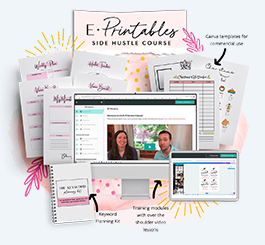
Free Training: Earn Money Selling Digital Printables
Not sure what to create or where to start? Gold City Ventures’ free workshop walks you through what sells, how to design it, and how to get your first sale
The Mindset Shift
Here’s the thing that separates sellers who plateau from sellers who keep growing.
At some point, you stop being someone with a side project and start being someone running a small business. That shift matters. It means treating your Etsy shop like it deserves your attention, checking your stats, planning your product pipeline, investing in your skills.
It also means being patient. Growth in this business is rarely dramatic. It’s incremental. You add a few listings, improve a few existing ones, build a bit more Pinterest traffic, raise prices slightly. Each of those things adds a small amount of revenue. But when they compound over months, the numbers start to look very different.
Treating it like a real business also means treating it like one at tax time. Once your monthly revenue is consistent rather than occasional, it’s worth actually knowing what you owe rather than guessing. Etsy Seller Taxes: What You Actually Owe covers how much to set aside and which of your Etsy fees and business expenses you can deduct.
Recommended reading: Gold City Ventures Review, if you want structured training to help you sell more printables and take your shop to the next level.
Keep building. You’ve already done the hardest part.