
Table of Contents

This post contains affiliate links. If you click through and buy something, I may earn a small commission, at no extra cost to you. I only recommend tools I’ve actually used or thoroughly researched.
If you’re not sure how to price printables on Etsy, you’re not alone. Figuring out how much to charge for printables is one of the first questions every new seller asks, and one of the easiest to get wrong.
Price too low and you signal “cheap” to buyers. Price too high without the listing quality to back it up and nobody clicks. Get it right and you’ve got a product that sells consistently and earns you a healthy margin on every sale.
The good news is that pricing printables isn’t guesswork. There’s real data to work with: competitor pricing, Etsy’s fee structure, and buyer behavior patterns that tell you where the sweet spot is.
Recommended reading: For the full picture of selling printables, start with How to Sell Printables Online.
Understanding Etsy’s Fees First
You can’t set a price without understanding what Etsy takes from each sale. Here’s the breakdown:
Listing fee: $0.20 per listing. This is charged when you publish the listing and again every time it sells (the listing auto-renews).
Transaction fee: 6.5% of the total sale price. This is Etsy’s commission.
Payment processing fee: Roughly 3% + $0.25 per transaction (varies slightly by country).
So on a $10 printable, your fees look like this: $0.20 (listing) + $0.65 (transaction) + $0.55 (processing) = $1.40 in total fees. Your take-home is $8.60.
On a $5 printable: $0.20 + $0.33 + $0.40 = $0.93 in fees. Your take-home is $4.07.
Notice something? The $0.20 listing fee and $0.25 processing flat fee hit much harder on lower-priced items. A $3 printable costs you $0.77 in fees, that’s 25% of the sale. A $15 printable costs you about $1.88, roughly 12.5%. The math gets better as your price goes up.
That’s one of several reasons not to race to the bottom on pricing.
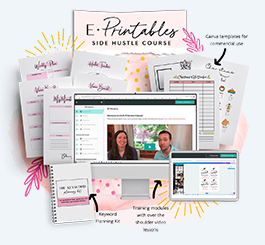
Free Training: Earn Money Selling Digital Printables
Not sure what to create or where to start? Gold City Ventures’ free workshop walks you through what sells, how to design it, and how to get your first sale
What Buyers Are Actually Paying
Based on my research across hundreds of Etsy printable listings, here’s where most products land:
Single-page printables (checklists, habit trackers, wall art prints): $2–$5
Multi-page printables (planners, worksheet sets, budget tracker bundles): $5–$12
Template bundles (sets of 3–5 related products): $8–$18
Digital planners (for GoodNotes/Notability with hyperlinks): $10–$30+
Wedding and event stationery sets: $8–$25
These ranges aren’t random. They reflect what buyers expect to pay in each category. Pricing well below these ranges doesn’t make you more competitive, it makes buyers wonder what’s wrong with your product.
Recommended reading: Best Printables to Sell for Beginners, understanding your category helps you set the right price.
How to Price Printables: The Strategy That Works
Step 1: Research Your Competitors
Go to Etsy and search for the exact type of printable you’re selling. Sort by “Best Selling” and look at the top 20 results. Write down their prices.
You’re looking for the range. If most budget planner printables sell for $5–$9, that’s your window. You don’t need to be the cheapest, you need to be within the range buyers expect. This is the core of Etsy printable pricing: match the market, don’t guess at it.
Pay attention to the listings with the most sales and best reviews. What are they charging? That price has been tested by the market over hundreds or thousands of sales. It works.
Step 2: Price in the Middle to Upper Range
Here’s what the data consistently shows: well-presented printables at the mid-to-upper end of the price range outsell cheap ones.
Why? Because price signals quality. A buyer comparing a $3 budget planner with blurry mockup images against an $8 one with clean lifestyle mockups and a detailed description will almost always choose the $8 one. They don’t want the cheapest, they want the one that looks like it’ll actually work.
If your competitors are charging $5–$9, price yours at $7–$8. Not at $3 hoping to undercut everyone. Not at $15 hoping to look premium. Right in the sweet spot where buyers feel they’re getting solid value.
Step 3: Create Bundles to Increase Your Average Sale
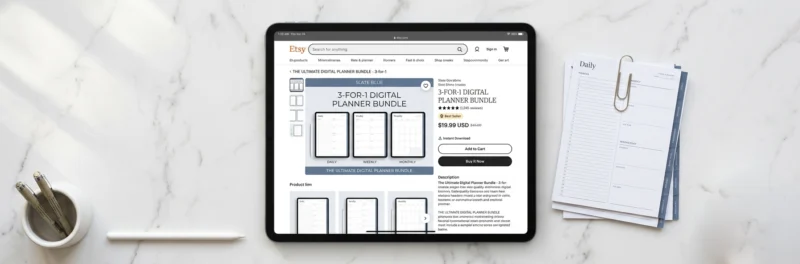
Bundles are one of the simplest ways to earn more per customer. Take 3–5 related printables and package them together at a price that’s slightly discounted compared to buying each one individually.
For example, if you sell individual budget trackers for $5 each, offer a “Complete Budget Printable Bundle” with five trackers for $15 instead of $25. The buyer gets a perceived deal, and you make a larger sale from a single transaction.
Bundles also help with Etsy’s algorithm. Higher-priced listings tend to have better engagement metrics because the buyer has invested more in their purchase, they’re more likely to leave a review, which helps your ranking.
Recommended reading: How to Sell Printables on Etsy, how to create listings that convert at your chosen price point.
Step 4: Don’t Undervalue Your Time
There’s a temptation with printables to think “it’s just a PDF, so it should be cheap.” But the buyer isn’t paying for the file format. They’re paying for the research you did to create something useful, the design work that makes it look professional, and the convenience of having it instantly.
A well-designed printable might take you 2–3 hours to create. If you sell it for $3 and get 10 sales a month, you’re earning $30 for those hours of work. If you sell it for $8 and get 8 sales a month (slightly fewer because of the higher price), you’re earning $64 from the same product. Higher price, better margins, fewer sales needed.
This is worth thinking about seriously, especially as you scale. You don’t need thousands of sales to make meaningful income if your pricing is right.
One more thing worth factoring into that math: the income is taxable, on top of Etsy’s fees, not instead of them. Etsy Seller Taxes: What You Actually Owe covers how much to set aside and which of these fees are deductible.
Recommended reading: How Much Can You Make Selling Printables?, realistic income expectations at different price points.
When to Raise Your Prices
Most sellers start too low and stay there too long. Here are a few signals that it’s time to raise your prices:
You’re getting consistent sales. If a product is selling steadily at $5, try raising it to $6 or $7. If sales don’t drop much, you’ve just increased your revenue by 20–40% with no additional work.
Your reviews are strong. Good reviews are social proof that your product is worth the price. When buyers are saying “this was exactly what I needed” or “great quality,” that’s the market telling you your price could be higher.
Your photos and descriptions have improved. Better listing quality supports higher prices. If you’ve upgraded your mockup images and rewritten your descriptions since you first listed, your products look more professional now, and they can command more.
Don’t be afraid to test. Etsy makes it easy to change prices, and you can always adjust back down if a specific increase doesn’t work.
Free Training: Earn Money Selling Digital Printables
Not sure what to create or where to start? Gold City Ventures’ free workshop walks you through what sells, how to design it, and how to get your first sale
Common Pricing Mistakes to Avoid
Racing to the bottom. Charging $1–$2 for a printable doesn’t make you competitive. It makes buyers suspicious and tanks your margins. Very few successful shops sell at the lowest end of the price range.
Ignoring fees in your calculations. Always factor in Etsy’s listing fee, transaction fee, and processing fee before deciding on a price. The number in your head and the number in your bank account are different things.
Setting one price and forgetting about it. Pricing should evolve. As you add more products, build reviews, and improve your listings, your prices should move up too.
Pricing based on effort, not value. Some of the simplest printables to create are also the most valuable to buyers. A one-page moving checklist that takes you 30 minutes to make might be worth $5 to a stressed buyer who needs it today. Price based on what the buyer gets, not how long it took you.
Recommended reading: How to Scale Your Printables Business, once your pricing is dialed in, here’s how to grow.
Start With the Data, Not Your Gut
Pricing doesn’t have to be stressful. Search Etsy, see what your competitors charge, price yourself in the mid-to-upper range, and create bundles. That’s the formula.
And if you want a more structured approach to pricing and everything else about selling printables, the Gold City Ventures free workshop covers pricing strategy alongside what to sell and how to get your first sale.
Recommended reading: Gold City Ventures Review, a full look at the course and what’s inside.
You’ve got this.